
Starlink’s Orbital Congestion: A Silent Inflection Threatening Connectivity’s Structural Future
This paper reveals a critically under-recognized structural inflection in global connectivity: the unchecked expansion of mega-constellations like Starlink is generating orbital congestion risks that could cascade into systemic disruptions across satellite internet infrastructure, regulatory regimes, and capital flows over the next two decades.
While the promise of global broadband via satellite constellations is well acknowledged, the emerging consequences of unregulated orbital saturation represent a weak signal poised to reshape how connectivity is governed, financed, and industrially organized. This signal is driven by the intersection of rapid launch cadence, nascent regulatory oversight, and the physical limits of near-Earth orbit capacity, all of which together form a fragile inflection point potentially requiring radical strategic recalibration from governments, investors, and technology providers.
Signal Identification
The expansion in satellite mega-constellations, particularly SpaceX’s Starlink V3 and beyond, qualifies as an emerging inflection indicator. Unlike a weak signal limited to emergent embryonic observations, this development is accelerating in scope and impact, with plausible systemic consequences over the next 10–20 years.
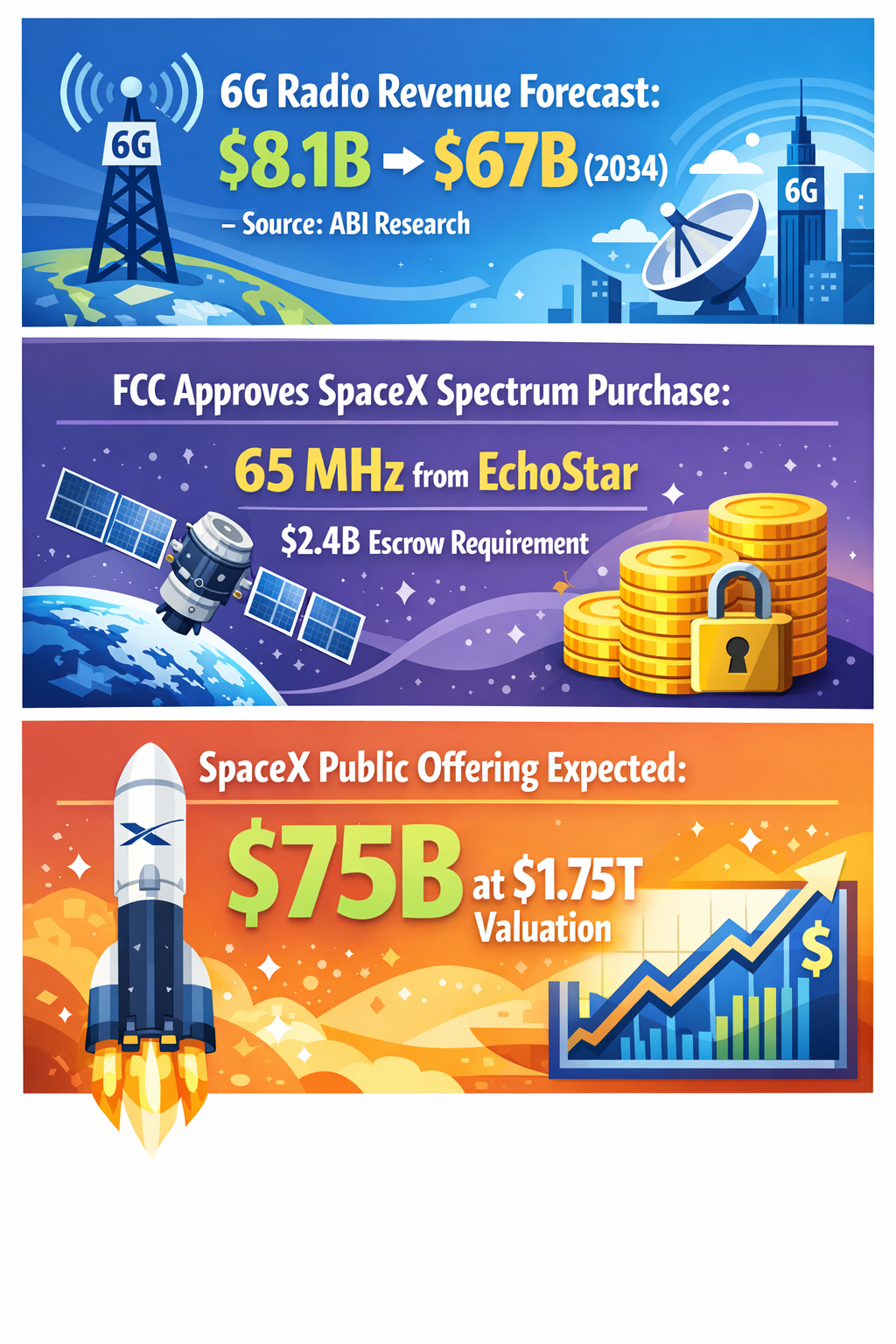
The plausibility band is high due to concrete launch schedules, regulatory filings, and valuation-driven capital allocation from SpaceX’s planned $75 billion public offering and $1.75 trillion valuation announcements (Yahoo Finance 04/06/2026)). It affects sectors spanning satellite communications, broadband consumer markets, spectrum regulation, and space traffic management.
What Is Changing
The satellite internet sector is undergoing rapid expansion marked by the deployment of multiple thousands of low Earth orbit (LEO) satellites. SpaceX’s Starlink has accelerated this trend with its V3 satellites, carrying upgraded solar arrays and high-capacity laser communications, intending to enhance throughput and lower service prices (RocketLaunch 02/06/2026)).
This scaling aims to disrupt incumbent broadband providers globally, particularly in lower-density markets, by making satellite broadband competitively priced (Light Reading 29/05/2026)). However, this expansion overlaps with a regulatory landscape that has yet to mature commensurately, ceding broad permissions and spectrum licenses (e.g., FCC's approval of SpaceX acquiring 65 MHz nationwide spectrum under escrow conditions) (Disruption Banking 18/06/2026)).
Recent analyses flag emerging orbital safety, collision, and security risks due to unregulated constellation growth—particularly highlighting dependencies that can destabilize orbital infrastructure and risk cascading failures (CES Intelligence 10/06/2026)). This constitutes a new systemic threat outside the typical terrestrial connectivity concerns, linking physical space environment stability to digital connectivity continuity.
Meanwhile, adjacent technology investments in IoT connectivity, 5G-enabled location-based services, and AI-driven supply chain analytics signal broad ecosystemwise digitization that increasingly relies on broadband resilience and capacity, thus amplifying the stakes of orbital infrastructure’s reliability (Persistence Market Research 01/06/2026); (Phoenix Research 05/06/2026)).
Disruption Pathway
The pathway from current constellation expansion to structural disruptions hinges on orbital congestion dynamics and regulatory responses.
As launches accelerate, the near-Earth orbital environment faces increased collision probability—both accidental and cascading through debris (Kessler Syndrome). Increased frequency of in-space collisions or near misses would stress satellite operators with heightened liability risks and demand for active debris removal technologies, currently immature and expensive.
This physical congestion pressures regulators to impose more stringent launch licensing, orbit coordination, and end-of-life deorbiting requirements. However, regulatory regimes nationally and internationally remain fragmented, partially reactive, and subject to geopolitical tensions over spectrum and orbital slots.
Concurrent investor appetite for rapid constellation deployments (SpaceX’s impending IPO with $75B capital raise target) underscores tension between capital markets’ growth expectations and the long-term sustainability of orbital assets.
These stresses could drive several systemic adaptations: a move towards centralized orbital traffic management authorities, widespread adoption of satellite traffic collision avoidance AI, enforced cross-operator interoperability standards, and novel insurance/liability frameworks for space infrastructure.
Unintended feedback loops may emerge if competitive pressures push satellite operators to maximize constellation density, paradoxically accelerating congestion and forcing regulatory crackdowns that dampen investment enthusiasm—potentially reshaping industry structure into oligopoly or state-sponsored monopolies that can control orbital access.
Ultimately, a shift in dominant industrial models—from rapid scale-first private ecosystem building to cautious, regulated, and interoperable infrastructures—could redefine strategic positioning, capital allocation, and regulatory design over the next 10 to 20 years.
Why This Matters
This inflection demands strategic attention because it directly affects capital allocation decisions within satellite broadband ventures, potentially altering valuation assumptions underpinning SkyFi, SpaceX, and other constellations’ expansion plans.
Regulatory frameworks face potential overhaul as existing spectrum licensing and orbital coordination mechanisms prove inadequate, potentially increasing compliance costs or introducing operational restrictions that disrupt anticipated revenues.
Industry structure may consolidate around players that can manage orbital congestion liabilities, affecting competitive dynamics and the broader tech ecosystem reliant on ubiquitous connectivity (e.g., IoT, AI-powered supply chains, mobility transaction systems).
Supply chain resilience for satellite manufacturing and launch services could be stressed due to more rigorous debris mitigation and regulatory compliance requirements, impacting upstream sectors.
Lastly, governance challenges around space safety escalate liability risks, which could generate new legal precedents affecting space operation insurance and intellectual property deployment strategies.
Implications
Unchecked orbital congestion could likely precipitate a paradigm shift in space-based connectivity from rapid growth to sustainable stewardship models within 10–20 years.
Capital markets might recalibrate valuations downwards or demand governance milestones as preconditions for funding. Regulators may impose binding international treaties for orbital traffic management, influencing investment timing and market entry.
Operators could be forced to embrace collaborative traffic monitoring AI, standardized interoperability protocols, or satellite “de-orbit” automation technologies that add costs but extend ecosystem longevity.
This development is not mere hype or a short-term logistical problem; it is a structural inflection threatening physical and financial infrastructure underpinning global connectivity.
Alternative interpretations argue that technological advances in collision avoidance and debris capture might alleviate congestion risks, but these remain nascent and lack scaling validation to date.
Early Indicators to Monitor
- Regulatory drafts and international agreements on orbital traffic management and debris mitigation
- Surge in capital reallocations or venture funding towards space debris removal or satellite collision avoidance technologies
- Emerging insurance products explicitly covering satellite collision and orbital debris liabilities
- Public-private partnerships forming for in-orbit servicing and debris removal
- Patent filings relating to AI-enabled orbital traffic control and satellite end-of-life automation
Disconfirming Signals
- Widespread deployment and proven efficacy of autonomous debris removal technologies significantly reducing collision/conflict events
- International regulatory harmonization achieving early, binding, and enforceable orbital use standards with rapid industry compliance
- Slowing or halting of constellation launches due to lack of capital or demand
- Development of viable alternative broadband delivery technologies that reduce reliance on LEO satellites materially
Strategic Questions
- How should regulators balance incentivizing satellite broadband expansion against emergent orbital safety risks to avoid structural ecosystem damage?
- What preconditions for capital deployment should investors demand to mitigate orbital congestion externalities and liability exposures?
Keywords
Starlink; Orbital congestion; Satellite internet; Space regulation; Space debris; Connectivity infrastructure; Capital allocation; Space traffic management
Bibliography
- Starship will carry 20 V3 Starlink satellites and extend high-capacity laser connectivity. RocketLaunch. Published 02/06/2026.
- Starlink's ability to lower prices and target incumbent broadband customers amid satellite expansion. Light Reading. Published 29/05/2026.
- Rapid, unregulated expansion of satellite constellations poses orbital safety and security risks. CES Intelligence. Published 10/06/2026.
- FCC approval for SpaceX’s purchase of 65 MHz nationwide spectrum for direct-to-device Starlink with escrow requirement. Disruption Banking. Published 18/06/2026.
- SpaceX’s Space Exploration satellite internet and AI company plans $75 billion IPO at $1.75 trillion valuation. Yahoo Finance. Published 04/06/2026.