
Urban Flood-Driven Smart Resilience: The Underrecognized Inflection in Asia-Pacific Megacities
Rapid urbanization in flood-prone Asian megacities combined with nascent climate-resilient technological investments signals a structural inflection. This weak signal of urban flood risk anticipating demand for integrated smart resilience infrastructure could transform capital flows, regulatory frameworks, and urban governance over the next two decades.
Urban growth in Asia-Pacific megacities is accelerating amidst intensifying climate impacts, especially monsoon-driven flooding affecting billions. While smart city initiatives and AI-driven urban infrastructure are well recognized, the embedded and scaling convergence of flood hazard management with real-time digital resilience represents a less highlighted structural trend. This inflection could reconfigure industrial leadership from conventional infrastructure builders and urban planners toward tech-enabled integrated resilience providers, while demanding new governance and funding models for climate-adaptive urban infrastructure.
Signal Identification
This development qualifies as an emerging inflection indicator due to its potential to fundamentally alter how urbanization integrates climate risk with digital infrastructure. It is distinct from the broader smart city and urbanization waves by focusing explicitly on flood resilience as a driver in urban infrastructure evolution.
The horizon for materializing this trend is medium to long term, i.e., 10–20 years, given the pace of climate impact intensification and infrastructure cycles.
Plausibility is high in Asia-Pacific megacities given their documented rapid urbanization in flood-prone zones, government-driven disaster resilience programs, and robust smart city investments.
Sectors exposed include urban infrastructure construction, digital/ICT systems providers, insurance and disaster finance, real estate development, regulatory bodies, and technology manufacturers focusing on AI, Internet of Things (IoT), and climate-resilient materials.
What Is Changing
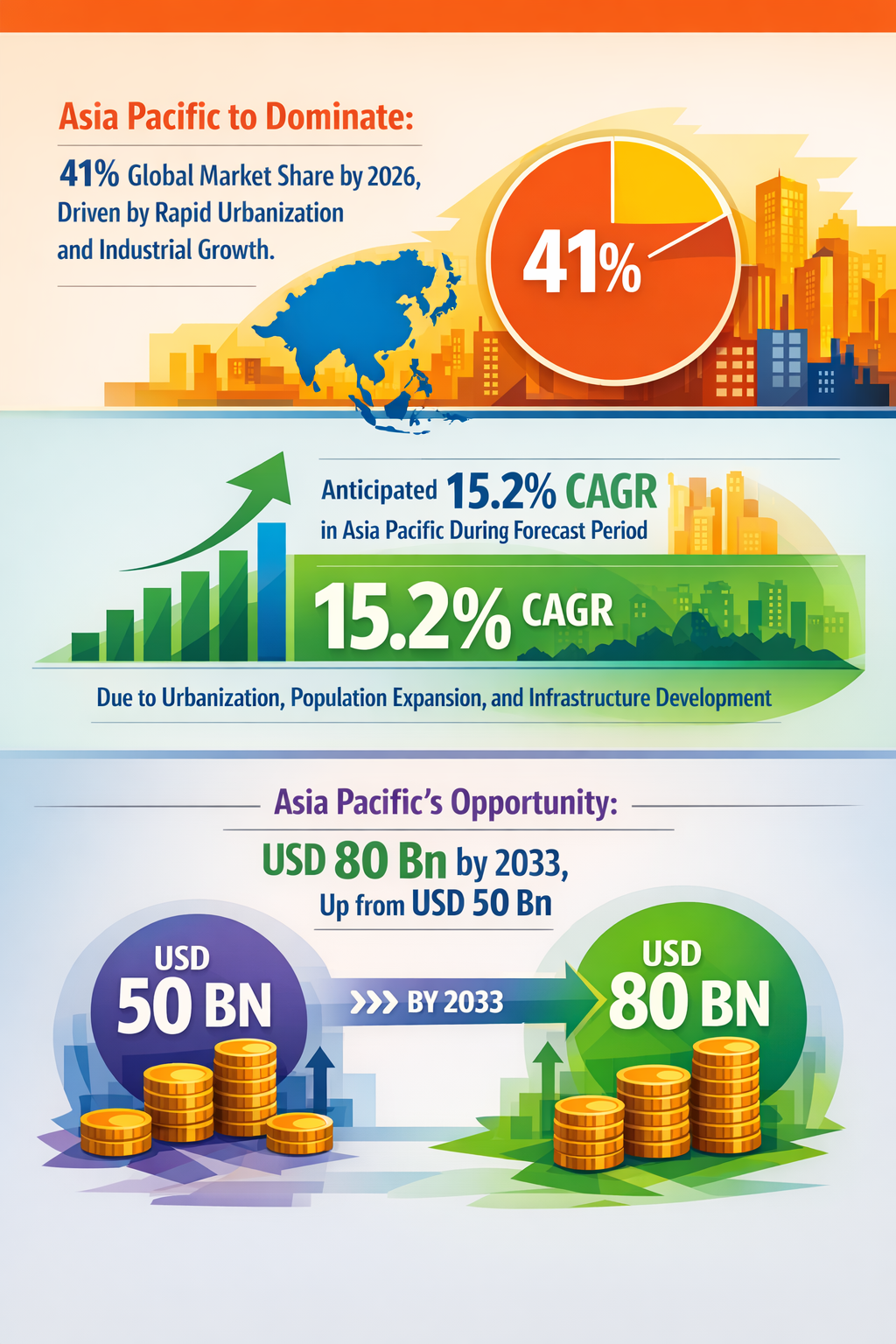
Multiple sources converge on Asia-Pacific as the fastest-growing urban region by population and infrastructure demand, with rapid urbanization especially in flood-vulnerable geographies such as India, China, Japan, and Southeast Asia (Persistence Market Research 15/03/2023; Spherical Insights 11/05/2023).
Government programs are not only emphasizing traditional infrastructure expansion but also integrating disaster resilience embedded in urban planning. This is illustrated by multilateral financing supporting projects that combine urban resilience with smart city ICT infrastructure, pushing innovation in climate-resilient technologies predicted to grow at a 19.4% CAGR through 2033 (Persistence Market Research 12/08/2023; Precedence Research 02/06/2023).
Parallel digitalization accelerates the fusion of IoT sensors, AI, behavioural data, and real-time flood warning and response systems, ushering a new era of what might be termed 'smart resilience infrastructure.' This infrastructure is self-monitoring, adaptive, and integrated across urban management functions (Market Data Forecast 22/04/2023; OpenPR 15/02/2024).
Less recognized is the systemic shift in risk governance and capital deployment this requires. Traditional capital allocation to segmented infrastructure (roads, drainage, buildings) is challenged by integrated flood risk management assets with layered digital controls. This can lead to new public-private partnership models, insurance-linked securities for flood resilience, and cross-sector regulatory frameworks aligning urban growth with climate adaptation priorities (Persistence Market Research 15/03/2023; RAND Corporation 10/09/2023).
Disruption Pathway
As climate-driven monsoon floods intensify across Asia-Pacific’s largest urban agglomerations, localized catastrophic flooding events may act as accelerators when conventional infrastructure proves insufficient. In reaction, governments and urban managers will escalate investments in smart, integrated flood warning and resilience systems.
This escalation will amplify stresses on existing fragmented urban service delivery, exposing vulnerabilities in governance coordination, capital allocation timing, and risk-sharing mechanisms. Urban resilience will increasingly be treated as an infrastructural system rather than isolated projects.
Structural adaptations may include creation of dynamic regulatory frameworks prioritizing flood risk real-time monitoring and resilience technology compliance; emergence of new financial instruments linking urban development permits and disaster risk financing; and increased role of multi-stakeholder platforms integrating technology firms, insurers, urban planners, and municipal authorities.
Feedback loops could arise as successful flood resilience infrastructure improves investor and insurer confidence, lowering risk premiums and unlocking additional funds for resilient urban development. Conversely, failure to effectively align digital resilience with urban growth would exacerbate social and economic costs, forcing policy reconsiderations and possibly urban migration.
The eventual dominance of this integrated urban flood resilience model could shift competitive dynamics in construction, smart tech, and finance, privileging firms and regions capable of delivering climate-adaptive smart city ecosystems over conventional urban infrastructure providers.
Why This Matters
For capital allocators, this inflection signals a pivot point to prioritize investments in integrated smart flood resilience technologies and infrastructure over traditional standalone assets. Early movers are likely to gain structural advantages as governments embed climate resilience into urban policy and funding eligibility.
Regulators will face intensifying pressure to develop comprehensive frameworks that mandate climate-resilience standards linked to digital monitoring and enforcement, redefining compliance and urban planning approval processes.
Industries positioned in siloed construction, urban infrastructure, and disaster finance must recalibrate strategies toward cross-sector integration with tech and data analytics providers that can enhance urban resilience.
Supply chains will be impacted by demand surges in climate-resilient building materials, sensor devices, AI platforms, and data management systems focused on flood monitoring and response.
Liability shifts may occur as urban resilience failures trigger legal exposures, prompting warranties and insurance products tethered to real-time system performance and environmental compliance.
Governance consequences include emergence of hybrid public-private platforms managing integrated urban flood resilience assets and enhanced citizen participation through real-time incident reporting and behavioural data collection.
Implications
This development may upend traditional urban infrastructure investment by embedding climate risk resilience as a baseline requirement rather than a premium add-on. It could catalyse new industrial alliances between construction firms and digital ecosystem providers, fostering sector consolidation and innovation leadership.
Regulatory bodies might create novel cross-sector standards that blend physical infrastructure codes with ICT cybersecurity and data privacy requirements related to urban monitoring systems.
While the emphasis on Asia-Pacific megacities is currently strongest, the model could diffuse globally, especially to other climate-vulnerable dense urban regions.
That said, this is not merely incremental smart city tech adoption nor infrastructure expansion—instead, it represents a system-wide integration of flood resilience as a defining parameter for urban growth and governance.
Some may interpret this as conventional risk management evolution, but its intersection with emerging digital infrastructure and finance systems suggests a more profound structural reconfiguration is likely.
Early Indicators to Monitor
- Surging venture capital and government funding toward integrated flood warning and urban resilience tech startups focused on real-time systems analytics and IoT sensor networks.
- Emergence and adoption of regulatory frameworks mandating climate-resilient digital infrastructure compliance in urban development permits.
- Formation of public-private partnerships specifically targeting integrated flood resilience infrastructure combining AI, IoT, and green building materials.
- Patent filings referencing AI-driven urban flood risk management systems, smart drainage, and self-healing materials designed for flood-prone zones.
- Increased issuance of disaster resilience-linked financial products (bonds, insurance) tied explicitly to urban smart infrastructure projects.
Disconfirming Signals
- Slower-than-expected deployment of real-time flood warning technology due to infrastructure or regulatory bottlenecks.
- Lack of integration between existing smart city projects and flood resilience initiatives, with continued silos in urban infrastructure investments.
- Withdrawal of multilateral or government funding supporting climate-resilient infrastructure in Asia-Pacific due to geopolitical or economic downturns.
- Preference for traditional grey infrastructure investments without digital enhancements despite escalating flood risks.
- Emergence of effective localized flood mitigation technologies that do not require systemic digital integration, reducing the impetus for broader structural change.
Strategic Questions
- How might regulatory frameworks need to evolve to mandate integration of real-time digital flood resilience systems in urban planning and financing?
- What are the potential partnership models across technology, infrastructure, and finance sectors that could accelerate deployment of integrated urban flood resilience in key megacities?
Keywords
urban resilience; flood risk management; smart cities; climate adaptation; IoT; AI; Asia-Pacific urbanization; disaster finance
Bibliography
- Fastest Growing Region: Asia Pacific is expected to achieve a 9.5% CAGR to 2033, driven by intensifying monsoons, rapid urbanization in flood-prone zones, and government programs strengthening disaster resilience across China, India, Japan, and Southeast Asia. Persistence Market Research. Published 15/03/2023.
- Asia-Pacific is projected to register the fastest growth during the forecast period, driven by rapid digitalization, a large technology-savvy population, expanding e-commerce ecosystems, and increasing investments in AI, IoT, and smart city initiatives. Market Data Forecast. Published 22/04/2023.
- Fastest Growing Region: Asia Pacific is the fastest-growing region, forecast to expand at a 19.4% CAGR during 2026-2033, driven by large-scale urban resilience initiatives, smart city programs, high climate vulnerability, and multilateral development financing. Persistence Market Research. Published 12/08/2023.
- Emerging economies across Asia-Pacific, particularly India, China, and Southeast Asian countries, are expected to witness substantial growth owing to rapid urbanization, increasing infrastructure investments, and supportive government initiatives. Spherical Insights. Published 11/05/2023.
- Digital and Smart City Alignment: The global smart city agenda and rapid expansion of urban charging infrastructure are expected to enhance long-term growth opportunities for electric vehicle manufacturers across all vehicle segments. OpenPR. Published 15/02/2024.
- Higher urbanization could be expected to boost economic growth and has been one of the main engines of China's economic boom through infrastructure development, economies of scale, innovation, and entrepreneurship. RAND Corporation. Published 10/09/2023.