
Hybrid Space-Ground Networks: The Under-Recognized Inflection Reshaping Global Connectivity
Emerging hybrid networks combining satellite constellations and terrestrial infrastructure stand to redefine global connectivity’s industrial and regulatory landscape over the next two decades. This development challenges existing capital allocations and spectrum governance by introducing orbital AI data centers and mesh architectures that blur traditional boundaries. While much of the industry focuses on incremental advances in 5G/6G and IoT densification, the systemic integration of space-based and ground-based networks remains a weakly recognized inflection with profound structural implications.
By critically evaluating recent launch cadence accelerations, ambitious satellite network architectures, and hybrid deployment models, this paper identifies how this hybridization could catalyze a paradigm shift in telecom infrastructure ownership, regulatory oversight, and international competition—potentially altering industrial dominances and policy frameworks from 2026 through 2040.
Signal Identification
This development qualifies as an emerging inflection indicator rather than a transient trend or speculative wildcard because it exhibits measurable acceleration in deployment scale, scope, and technical complexity across multiple dimensions of network design and strategic architecture. The timeline is medium-to-long term (10–20 years), reflecting current capital-intensive buildouts expected to mature between 2030 and 2040. Its plausibility is high, grounded in corporate commitments and regulatory shifts supporting integrated architectures.
Sectors exposed include telecommunications infrastructure, satellite manufacturing, cloud and AI data services, government spectrum management, and industrial verticals dependent on increasingly pervasive IoT and critical mission connectivity.
What Is Changing
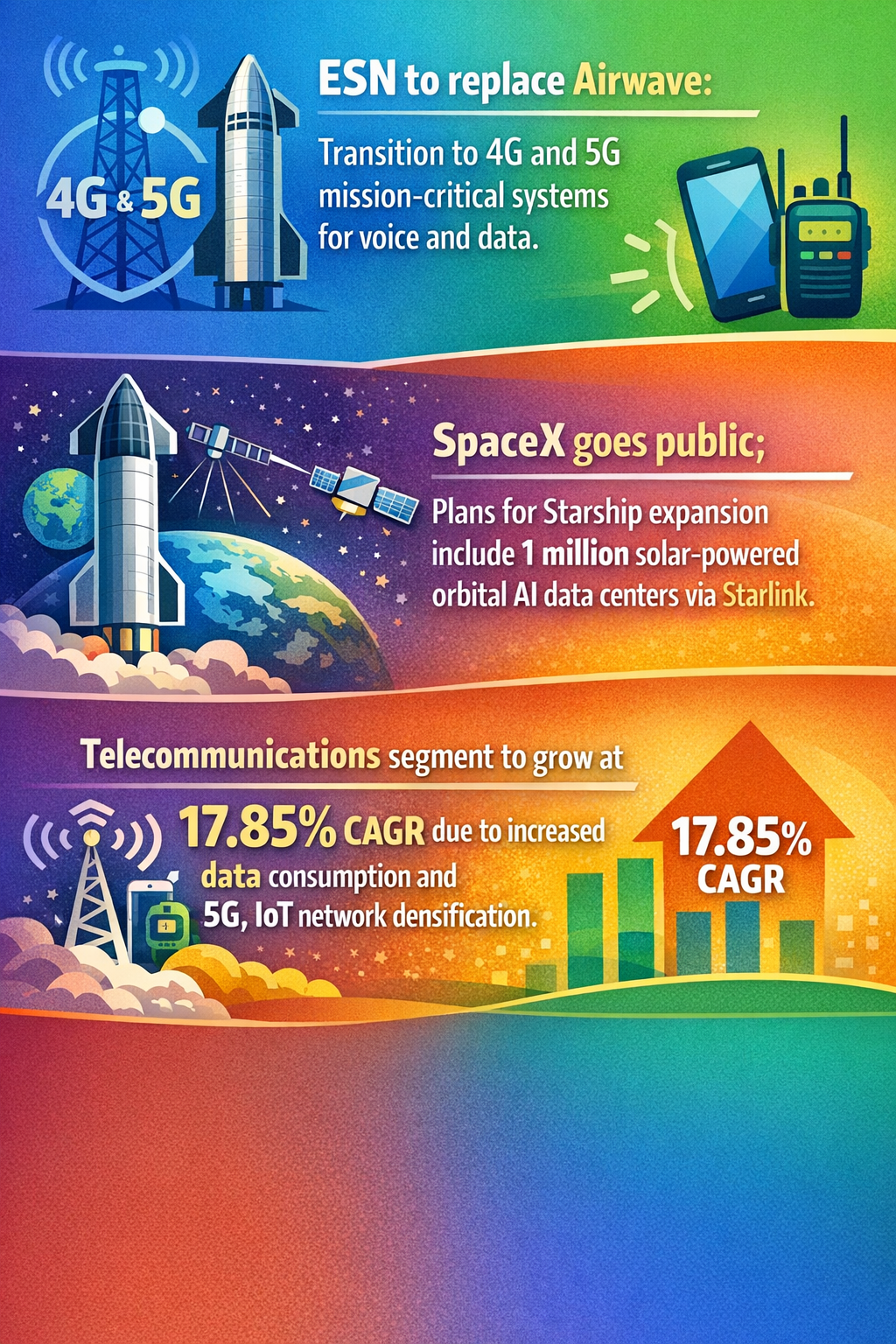
The telecommunications ecosystem is witnessing an unprecedented convergence of space-based satellite constellations, such as Starlink operated by SpaceX, with terrestrial wireless infrastructures including 5G and planned 6G networks. SpaceX's commitments to deploy up to one million solar-powered satellites engineered as orbital AI data centers (Channel News Asia 21/08/2026) and plans for Starship reusable rocket launches to massively increase deployment cadence (The Register 21/08/2026) highlight the scale and ambition of this trend.
Simultaneously, traditional cellular operators and new market entrants anticipate the explosive rise in data consumption and network densification driven by 5G and IoT ecosystems, with over 38 billion IoT connections projected globally by 2030 (MarkNtel Advisors 29/07/2026). Yet, innovation is moving beyond incremental densification: SpaceX’s hybrid network model proposes combining satellite connectivity with ground infrastructure where femtocells or traditional towers cannot efficiently provide coverage (Proactive Investors 03/07/2026).
These developments signal a substantive structural theme: the erosion of rigid terrestrial-vs-satellite network silos into hybrid mesh architectures that fuse ground and orbital assets. This creates new service paradigms—like ubiquitous seamless coverage spanning urban, rural, maritime, and airborne domains—as seen in Lufthansa Group’s initiative to deploy high-speed Starlink internet across 850 aircraft by 2029 (Future Travel Experience 15/04/2026).
Moreover, this emerging network hybridization dovetails with the deployment of Industrial Internet of Things (IIoT) sensors, mission-critical emergency services networks shifting to 4G/5G Enhanced Services Networks (ESN) (UK Government 27/07/2026), and AI-driven data aggregation platforms, stressing existing industry and regulatory frameworks.
Disruption Pathway
The expansion of hybrid space-ground networks may accelerate rapidly under several reinforcing conditions: continued reductions in launch costs through reusable rockets, technological maturation of low-earth orbit (LEO) satellite AI processors, and regulatory openness to spectrum-sharing innovations. As SpaceX demonstrates feasibility with V3 Starlink satellites deployed by Starship launches (The Register 21/08/2026), investor and capital market confidence could reallocate funding from terrestrial-only telecom infrastructures to hybrid network builds.
This progression will stress incumbent communication frameworks, which are historically siloed and geographically segmented. Traditional operators may face competitive pressure to divest or entirely restructure their physical assets and network architectures. Equally, national spectrum authorities and international regulatory bodies will encounter complex challenges balancing orbital slot allocations, interference management, cross-border frequency harmonization, and cybersecurity paradigms—an area inadequately addressed by current frameworks that assume terrestrial-centric models.
Structural adaptations could include new forms of public-private partnerships overseeing orbital infrastructure, emergence of integrated network service providers combining satellite and terrestrial assets, and the gradual rise of software-defined network overlays optimizing heterogeneous resource use. Unintended consequences might encompass increased geopolitical contestation over space-based resources and data sovereignty, as well as novel liabilities spawned by AI-operated orbital data centers, including automated decision-making risks and accountability gaps.
This evolving ecosystem might induce feedback loops where hybrid network capability fuels higher data consumption and IoT proliferation, which in turn justify further orbital and ground asset investment, institutionalizing the hybrid architecture as the global connective backbone.
Why This Matters
For capital allocators, this shift underscores the risk of stranded assets in purely terrestrial infrastructure and suggests evaluating investment exposure to vertically integrated space-ground service providers. Regulators must proactively reconsider spectrum management, safety, and data privacy regulations aligned with hybrid systems’ technical realities and international competitive pressures.
From an industrial strategy perspective, telecommunications incumbents face disruption from vertically integrated satellite operators aggressively expanding service footprints and offering novel AI-enabled functionalities, potentially redefining competitive positioning in global digital infrastructure markets. Supply chains might realign towards space-qualified components, AI hardware, and ground integration technologies, reshaping industrial geographies.
Governance implications include a pressing need for new multilateral frameworks to manage orbital resource use, cyber-physical security, and AI oversight in space-born infrastructure. Liability frameworks may also evolve to address automated fault diagnosis and recovery systems that blend in-orbit and terrestrial components.
Implications
This hybrid networking trend may transform telecommunications from geographically constrained cellular and fixed-broadband models into a globally integrated mesh, enabling unprecedented coverage and service reliability. It is likely to redistribute capital flows substantially across satellite manufacturing, launch services, and terrestrial network integration sectors.
The change could also drive regulatory innovation, producing novel licensing, data governance, and spectrum allocation regimes more suited to a hybrid orbital-terrestrial system. However, this is not merely an extension of 5G/6G or IoT proliferation but a potentially systemic redefinition of connectivity infrastructure and governance.
Competing interpretations might argue this is an extension of existing satellite constellations and wireless network densification with manageable incremental changes rather than a paradigm shift. Nonetheless, the scale of planned orbital AI satellite deployment and hybrid integration strategies makes this interpretation increasingly tenuous.
Early Indicators to Monitor
- Commercial Starship launch cadence and successful deployment of Starlink V3 satellites featuring onboard AI data centers (The Register 21/08/2026>).
- Capital reallocations by telecom incumbents towards hybrid network R&D and satellite partnerships (Channel News Asia 21/08/2026>).
- Regulatory consultations and spectrum licensing innovations accommodating integrated orbital-terrestrial infrastructures (UK Government 27/07/2026>).
- Emerging public-private partnerships or joint ventures combining satellite and ground network assets (Proactive Investors 03/07/2026>).
- Adoption rates of hybrid connectivity in strategic verticals such as aviation with Lufthansa’s Starlink WiFi rollout plans (Future Travel Experience 15/04/2026>).
Disconfirming Signals
- Repeated launch failures or sustained delays in Starship operations undermining satellite deployment scale and frequency (The Register 21/08/2026>).
- Regulatory clampdowns restricting spectrum use or prohibiting hybrid network licensing models.
- Failure of AI capabilities onboard satellites to demonstrate operational advantages, leading to reduced investment.
- Entrenchment of dominant terrestrial telecom incumbents resisting network integration or consolidating space-based initiatives.
- Geopolitical conflicts limiting cross-border orbits, frequency harmonization, or data governance cooperation.
Strategic Questions
- How should capital allocation balance between terrestrial infrastructure upgrades and integrated space-ground network investments over the next decade?
- What regulatory frameworks need development now to govern hybrid orbital-terrestrial connectivity architectures and their AI operational components?
Keywords
Hybrid networks; LEO satellites; Orbital AI data centers; 5G integration; Telecommunications regulation; Satellite networks; IoT connectivity; SpaceX Starlink; Industrial IoT; Network densification
Bibliography
- Lufthansa Group has launched free high-speed Starlink WiFi, with an ambitious rollout planned across around 850 aircraft by 2029 to deliver a consistent, high-quality connectivity experience across its airlines and travel classes. Future Travel Experience. Published 15/04/2026.
- Beyond 5G lies 6G, expected in the 2030s. Plunkett Research. Published 01/02/2026.
- SpaceX could pursue a hybrid network combining Starlink satellites with ground infrastructure, including towers where femtocells cannot provide sufficient coverage. / USA. Proactive Investors. Published 03/07/2026.
- Starship is expected to reach operational orbit on its next test flight and deploy a batch of Starlink V3 satellites if all goes to plan. The Register. Published 21/08/2026.
- The current Airwave system will be replaced by ESN as global direction and supplier markets are moving away to newer 4G and 5G based systems that support both mission-critical voice and data. UK Government. Published 27/07/2026.