
Demographic-Driven Infrastructural Hollowing: The Hidden Migration Constraint Reshaping Global Mobility
Emerging demographic-induced voids in critical municipal infrastructures represent an overlooked weak signal with transformative implications for migration and mobility. This signal highlights the risk of structural undermining of migration systems due to local capacity collapse rather than traditional border enforcement or policy shifts alone.
While declining migration flows and political disputes attract mainstream attention, the gradual disappearance of municipal viability in origin and destination countries threatens to cascade into systemic failures of physical and social infrastructure along migration corridors. Such infrastructural hollowing may fundamentally recalibrate the economics, governance, and geography of migration over the next two decades.
Signal Identification
This development qualifies as a weak signal with emerging inflection characteristics. It is weak because current migration discourse largely focuses on policy, border controls, political tensions, or demographic aging in isolation, whereas the progressive disappearance of municipalities—as documented in key migrant source countries—is not widely framed as a mobility constraint.
The signal horizon is medium to long term (10–20 years), given municipal collapse is a slow-moving structural process driven by demographic decline combined with socio-economic attrition. The plausibility band is high based on clear demographic projections and observed municipal population shrinkage. Key sectors exposed include urban infrastructure, civil governance, regional development, migration management, and international economic policy.
What Is Changing
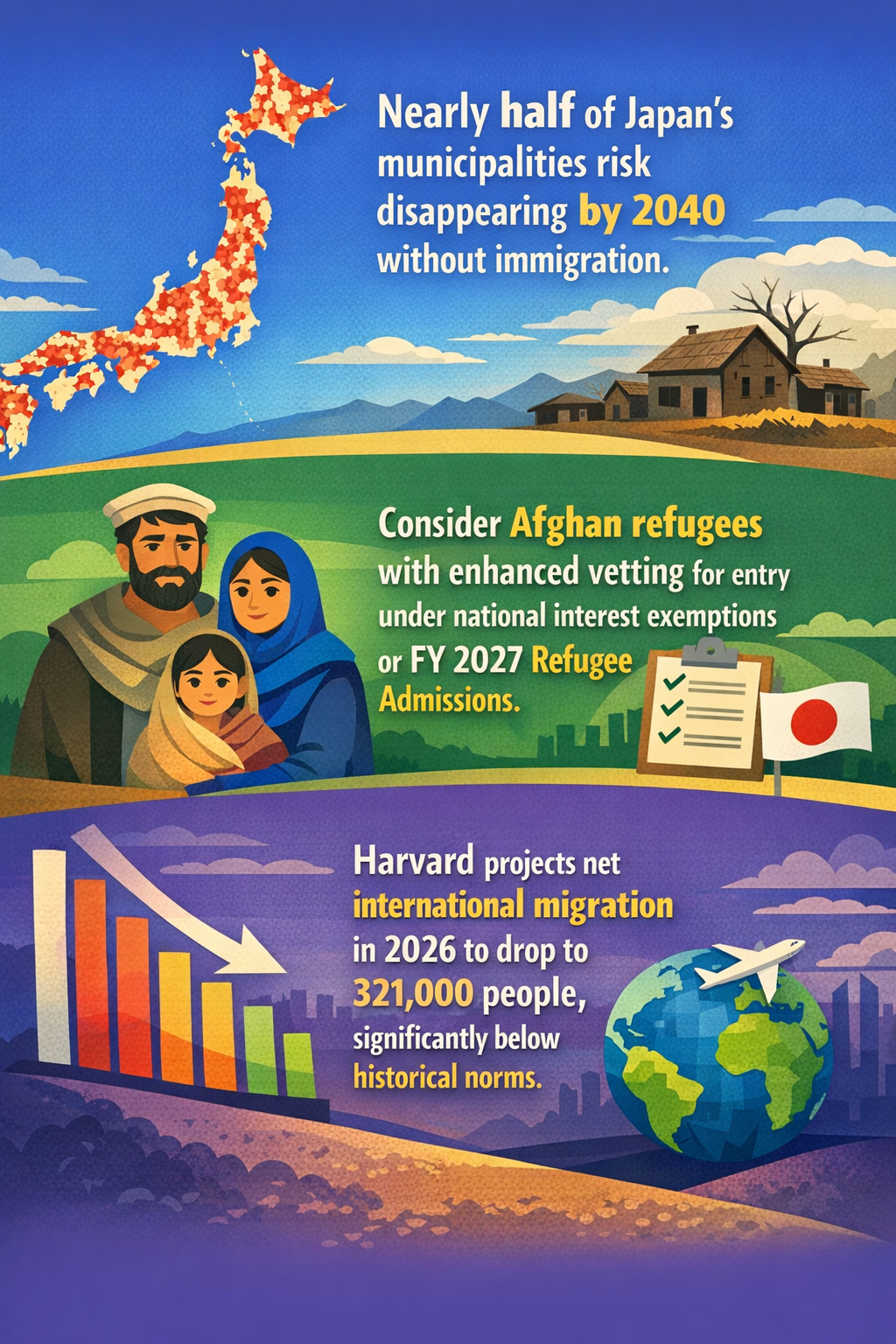
Multiple articles underscore demographic decline's severe local impacts but treat them discretely. Japan’s risk of losing nearly half its municipalities by 2040 reflects a critical vulnerability in the very place-based capacity to sustain populations (Emerging Markets Skeptic 08/06/2026). Such hollowing implies loss of service delivery, education, healthcare, transport access, and local governance effectiveness.
Similarly, Spain’s projected 19% GDP shortfall without immigration underscores the country’s growing dependence on migrant labor to sustain not only economic activity but foundational urban and rural infrastructure (CPA UK Business News 01/07/2026). Without sufficient inflows to counterbalance natural declines, municipalities facing depopulation become less viable migration destinations or transit points.
Adding complexity, Harvard’s projection of net international migration drastically falling to 321,000 in 2026 signals a contraction in demand for urban housing and services in key economies (HousingWire 01/07/2026). The decreased viability of urban and regional infrastructure due to collapses at municipal levels feeds back into these migration reductions by eroding the attractiveness and practical feasibility of relocation.
When coupled with geopolitical frictions exemplified by the death of a Mexican in Houston affecting US-Mexico relations (CNN 12/07/2026) and growing complexities in asylum systems managed by agencies like UNHCR (United Nations News 06/07/2026), these infrastructural weaknesses become critical choke points potentially limiting both voluntary and forced migration flows.
Disruption Pathway
The gradual depopulation of municipalities creates conditions that could escalate infrastructural hollowing into a migration mobility constraint. As local service delivery collapses, potential migrants face deteriorating living conditions at traditional destinations, compelling them either to reroute migration pathways or to forego migration altogether.
This differential erosion of infrastructure introduces significant stresses on both origin and destination regions. Origin municipalities lose the tax base, political legitimacy, and operational capacity to support population retention or constructive emigration policies. Destination regions see shrinking labor pools and reduced economic dynamism necessary to absorb migrants, creating a negative spiral.
Structural adaptation may emerge as regions invest in "migration corridors" that explicitly prioritize infrastructural sustainment or development along major movement routes, akin to the UNHCR’s whole-route approach (United Nations News 06/07/2026). Governance models could evolve to incorporate place-based infrastructural resilience metrics as essential criteria for migration policy and capital allocation.
Feedback loops are plausible: failing infrastructure reduces migration inflows that might otherwise sustain or rejuvenate municipal economies, accelerating decline. Conversely, failure to secure infrastructure undermining migration corridors could provoke political instability, further constraining mobility.
In this scenario, dominant industry and regulatory models may shift from border-centric migration control to integrated socio-infrastructural ecosystem management. Capital investment strategies might pivot toward municipal regeneration and connectivity enhancement, prioritizing long-term systemic viability over short-term migratory flow management.
Why This Matters
For senior decision-makers, this signal reframes migration not merely as a demographic or policy challenge but as an infrastructural sustainability issue. Capital allocation exposed includes urban regeneration funds, regional infrastructure investment, and housing development capital, which may be redirected toward smaller or emerging municipalities at risk of disappearance or infrastructural collapse.
Regulatory frameworks must evolve to integrate cross-sectoral assessments encompassing migration flows, local government capacity, and infrastructure resilience. Competitive industrial positioning may shift as regions proactively strengthen their infrastructural ecosystems to attract and retain migrant labor and consumption bases.
Supply chain effects could emerge as shrinking municipalities disrupt local markets and transportation nodes, potentially shifting migration-linked labor sourcing strategies. Liability shifts may arise related to governance failures in managing population decline and migration spillovers. Governance consequences include a need for multi-level coordination across urban planning, migration policy, and international cooperation frameworks.
Implications
Municipal infrastructural decline may likely evolve from a background demographic phenomenon into a primary limiting factor for global migration and mobility shifts within 10–20 years. This could produce structural economic contractions in affected countries and regions, as labor shortages and diminished local demand feed into wider economic fragility.
While transient policy shifts and bilateral tensions remain critical, they might ultimately represent surface-level disruptions overlaid on deeper infrastructural decay. This development should not be misconstrued as merely an urban decline narrative disconnected from global migration dynamics. Competing interpretations might undervalue infrastructure’s role, instead blaming purely political or economic migration drivers.
Ultimately, focusing on the viability of municipalities as functional units within migration systems offers a more holistic lens to predict where and how migration flows may contract, reroute, or evolve structurally.
Early Indicators to Monitor
- Trends in municipal population changes and service delivery capacities, particularly in known migrant origin and transit regions
- Government and private sector capital flows targeting municipal infrastructure rehabilitation or abandonment
- Policy drafts or frameworks integrating place-based infrastructural metrics into migration or regional development planning
- Funding patterns in urban and regional housing stock relevant to migrant absorption capacity
- UNHCR and international agency reports tracking migration corridor resilience beyond border enforcement metrics
Disconfirming Signals
- Sudden population rebounds in at-risk municipalities driven by breakthrough economic or technological interventions
- Rapid scaling of urban infrastructure via new construction, digital connectivity, or automation relieving demographic pressures
- Effective policy harmonization that decouples migration volumes from local infrastructure dependencies
- Significant loosening of migration-related geopolitical friction that compensates for infrastructural weak points
Strategic Questions
- How do current capital allocation strategies incorporate municipal infrastructural viability as a determinant of migration potential?
- What institutional arrangements are needed to integrate migration policy with infrastructure and regional development governance?
Keywords
Demographic Decline; Municipal Collapse; Infrastructure Resilience; Migration Policy; Regional Development; Supply Chain Disruption; Labor Mobility; Urban Regeneration
Bibliography
- Without immigration, nearly half of all municipalities in Japan are at risk of vanishing entirely by 2040. Emerging Markets Skeptic. Published 08/06/2026.
- Spain's GDP could be 19% smaller by 2050 without immigration. CPA UK Business News. Published 01/07/2026.
- Harvard projects net international migration could fall to roughly 321,000 people in 2026, dramatically below historical norms. HousingWire. Published 01/07/2026.
- The death of a Mexican man in Houston at the hands of Immigration and Customs Enforcement is threatening to upend already-strained relations between Mexico and the United States. CNN. Published 12/07/2026.
- The UN refugee agency, UNHCR, is taking a whole-of-route approach to reduce risks along mixed movement corridors and strengthen asylum systems. United Nations News. Published 06/07/2026.