
Emerging Regulatory and Coverage Dynamics as a Wildcard in the Future of Diet Drugs
This paper explores an under-recognized wildcard in the diet drug sector: the emerging divergences in insurance coverage and regulatory responses to GLP-1 receptor agonists and related therapies. These dynamics could reshape capital flows, regulatory frameworks, and strategic positioning across healthcare, pharma, and payor industries over the next 5–20 years.
While much attention focuses on blockbuster drugs like semaglutide and tirzepatide, a non-obvious inflection is brewing in how public and private payors are responding to cost, safety, and access pressures. Increasingly fractured coverage policies combined with emerging safety concerns suggest a potential systemic disruption, challenging entrenched assumptions of continual demand growth and uninterrupted market expansion for obesity drugs.
Signal Identification
This development qualifies as a wildcard by virtue of its present low visibility and outsized potential to disrupt multiple aspects of the diet drug ecosystem over the medium term (5–10 years). It is plausible and of medium to high probability given current coverage cuts and emerging safety reports. The core sectors exposed include biopharma, healthcare insurance, regulatory agencies, telehealth providers, and nutrition innovation firms.
Unlike the broadly recognized blockbuster success trajectory of GLP-1s, this signal points to a countervailing pressure that might significantly reshape demand and regulatory frameworks. Its disruptive potential lies in cascading effects across capital allocation, coverage policy, industrial strategy, and patient access paradigms.
What Is Changing
Two core, under-analyzed themes emerge from recent developments: first, the growing willingness of public payors to restrict or withdraw coverage of GLP-1 weight loss drugs; second, emergent safety signals reshaping perceptions of these drugs’ risk-benefit profiles.
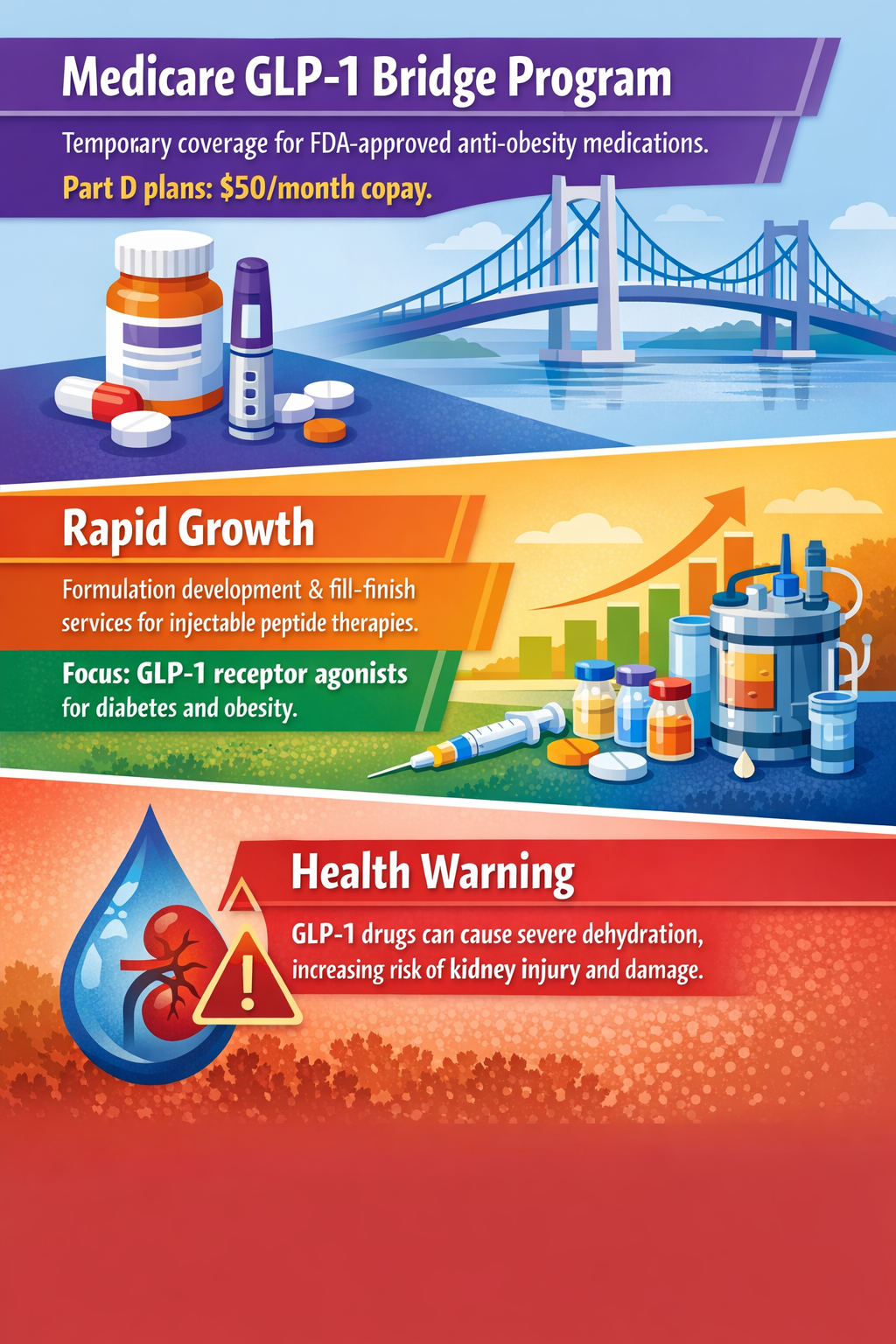
The Group Insurance Commission in Massachusetts, responsible for benefits for public employees, has announced plans to remove coverage for costly GLP-1 drugs like Wegovy and Zepbound (WBUR 23/06/2026). This reflects deeper cost-containment efforts amid budgetary strain and rising drug prices. Meanwhile, Medicare’s temporary GLP-1 Bridge Program, facilitating coverage at a capped $50 monthly copay, signals intent to balance access with cost controls—but remains provisional and limited in scope (Pound of Cure Weight Loss 20/04/2026).
Concurrently, on the risk side, health advisories are emerging on severe dehydration associated with GLP-1 use, raising kidney injury concerns especially under heat stress conditions (Healthline 15/05/2026). These developments bring to light liabilities and safety implications that payors and regulators cannot ignore.
Additionally, telehealth platforms like Hims and Hers are experiencing an influx of patients increasingly denied insurance coverage, pushing the market toward out-of-pocket and subscription-based models (Scripps News 28/05/2026). This dynamic destabilizes traditional insurance reimbursement routes and opens new competitive challenges.
Nutrition sector actors are concurrently accelerating development of “GLP-1 companion nutrition” products, signifying industry adaptation beyond drugs alone, driven by consumer demand for adjuncts and alternatives to prescription therapies (Food Ingredients First 19/04/2026).
Layered onto these trends is a patent cliff looming in the early 2030s with semaglutide generics tightly regulated or currently illegal in the US (Treated 12/03/2026). This will complicate market structures and pricing dynamics across the coming decade.
Disruption Pathway
This wildcard could evolve into structural change through a multi-stage process. First, continued public and private insurance cuts under fiscal pressures may make high-cost GLP-1 drugs increasingly inaccessible for many patients, reversing what appeared to be a secular demand growth trajectory. This will amplify out-of-pocket burden and increase reliance on telehealth, online marketplaces, and unregulated product streams.
Second, mounting safety concerns, particularly around hydration and renal impacts, could compel regulatory agencies to impose stricter labeling, monitoring requirements, or even usage restrictions, increasing compliance costs and limiting pharmaceutical incumbents’ market freedom. This may incentivize investment in alternative therapies including nutrition adjuncts and novel delivery modalities.
Third, pharmaceutical companies and payors may develop integrated “companion ecosystem” approaches combining prescription GLP-1s with nutrition, lifestyle programs, and telehealth support, reshaping value propositions and industrial boundaries.
Escalating tensions between price, coverage, and safety could trigger feedback loops. Reduced insurance coverage limits drug uptake, lowering pharma revenues and rebalancing innovation priorities toward adaptable digital and nutritional complements rather than solely new molecules. Meanwhile, public dissatisfaction with access barriers may provoke policy shifts or emergence of grey markets.
Ultimately, this vector could break the current paradigm of sustained GLP-1 blockbuster dominance, yielding a more fragmented market with mixed public-private coverage, hybridized drug-nutrition solutions, and new regulatory modalities balancing cost containment with patient safety.
Why This Matters
Decision-makers allocating capital must recognize that the blockbuster GLP-1 market trajectory faces significant regulatory and reimbursement inflection risks. Pharmaceutical firms may need to recalibrate R&D and commercial strategies toward integrated ecosystem plays rather than standalone drugs.
Regulators and payors will confront complex governance challenges navigating cost pressures, emerging safety data, and equity considerations, which may prompt new coverage frameworks and labeling rules impacting industrial profitability and patient access.
Telehealth and nutrition sectors might seize structural growth opportunities as access shifts from traditional insurance models to alternative delivery and companion product markets, thus altering industrial structure and supply chains.
Lastly, liability exposures for adverse effects could catalyze new compliance regimes and raise risk capital costs, especially as heat-related illnesses increase alongside drug use.
Implications
This development may lead to fragmented coverage landscapes where public payors selectively cover GLP-1 drugs while private insurers vary coverage, fueling expansion of direct-to-consumer and telehealth channels. It might also catalyze broader regulatory oversight on safety profiles and dosing limitations, altering risk-reward calculations.
This is likely structural rather than transient, as entrenched cost pressures and emergent safety issues are not ephemeral trends. However, its pace and scale depend on political, epidemiological, and patent-related factors.
This signal is distinct from incremental innovation narratives; rather, it points to systemic stress and potential paradigm shift in how obesity pharmacotherapy is accessed, reimbursed, and integrated into broader health ecosystems.
Competing interpretations could view coverage cuts as temporary austerity measures or emphasize ongoing molecular innovation as dominant, but ignoring coverage and regulatory shifts risks strategic blind spots.
Early Indicators to Monitor
- Additional states or federal agencies announcing GLP-1 coverage restrictions or cost-control programs.
- Regulatory guidance or warnings relating to GLP-1 safety concerns, especially dehydration and kidney injury.
- Rising venture capital activity in GLP-1 companion nutrition or telehealth weight management platforms.
- Pharmaceutical R&D pipeline shifts prioritizing combination therapies or alternative obesity treatments.
- Increase in consumer out-of-pocket expenditure surveys and telehealth prescription volumes in the GLP-1 category.
Disconfirming Signals
- Large-scale expansions of public payor coverage without cost caps or restrictions globally.
- No further regulatory action or consensus around safety concerns, with adverse event rates stabilizing or declining.
- FDA or analogous regulators approving generic semaglutide products with benign market impacts before 2032.
- Blockbuster sales growth continuing unhindered despite cost pressure indications.
- Failure of nutrition companions or telehealth subscription models to gain measurable market traction.
Strategic Questions
- How should pharmaceutical companies balance investment between standalone GLP-1 molecules versus integrated drug-nutrition-health ecosystems?
- What regulatory frameworks will most effectively balance cost control, safety assurance, and innovation incentives in obesity pharmacotherapy?
Keywords
GLP-1; Weight Loss Drugs; Insurance Coverage; Regulatory Risk; Pharmaceutical Patent Cliff; Nutrition Companion Products; Telehealth; Drug Safety; Cost Controls
Bibliography
- Healthcare in 2026: A sector caught between a patent cliff and a supply shock. Blogs On Markets. Published 22/04/2026.
- IFT FIRST 2026: GLP-1 companion nutrition to rapidly evolve commercially. Food Ingredients First. Published 19/04/2026.
- Until generic semaglutide is available, generics are unregulated or illegal in the US. Treated. Published 12/03/2026.
- Insurance increasingly dropping weight loss drugs like Wegovy, Zepbound. Scripps News. Published 28/05/2026.
- Massachusetts cutting GLP-1 coverage for Medicaid and public employees. WBUR. Published 23/06/2026.
- Severe dehydration from GLP-1 drugs may increase kidney injury risk. Healthline. Published 15/05/2026.
- The Medicare GLP-1 Bridge Program coverage overview. Pound of Cure Weight Loss. Published 20/04/2026.