
The Hidden Inflection: Far-Right Authoritarianism’s Quiet Clash with Corporate and Regulatory Norms
This paper reveals a subtle but consequential weak signal within the rising far-right wave—its disruptive impact not merely as a political force but as a systemic strain on institutional norms governing corporate governance, regulatory frameworks, and capital allocation. Beneath the headline growth of far-right populism lies an underappreciated dynamic: a persistent challenge to operational legitimacy in sectors ranging from charities and nonprofits to multinational firms and governments, potentially triggering governance innovations or retrenchments within 5–20 years.
While widespread concern focuses on electoral outcomes and extremist violence, few analyses highlight how far-right authoritarianism is quietly transforming risk profiles, compelling structural recalibration in compliance regimes, investment risk assessments, and organizational resilience strategies. This shift signals a strategic inflection point capable of reshaping industrial and regulatory architecture in advanced economies.
Signal Identification
This development qualifies as an emerging inflection indicator rather than a transient trend or mere wildcard. It is grounded in multiple corroborated signals from diverse sectors indicating far-right authoritarianism’s deepening entrenchment as an operational threat vector across civil society and corporate ecosystems. It is neither speculative nor widely appreciated beyond political discourse; rather, it represents a cross-sector structural challenge requiring sustained strategic response.
Time horizon: 5–20 years.
Plausibility band: High.
Sectors exposed include corporate governance, financial services, nonprofit/charitable sectors, regulatory bodies, and risk management functions.
What Is Changing
Recent reports indicate that more than half of charity sector leaders identify the rise of far-right authoritarianism as an existential threat to their organizations (Third Sector 05/05/2026). This underscores a novel risk zone where ideological antagonism manifests as operational obstructionism, donor intimidation, and reputational hazards—disciplines customarily under-recognized in traditional risk frameworks.
Simultaneously, terrorism trends in the UK reveal a symmetric rise in threats from extreme right-wing actors, paralleled by Islamist extremism (Religion Media Centre 01/05/2026). This normalization of far-right violence enhances security burdens and complicates due diligence efforts within organizations, affecting capital providers’ risk appetite and insurance underwriting.
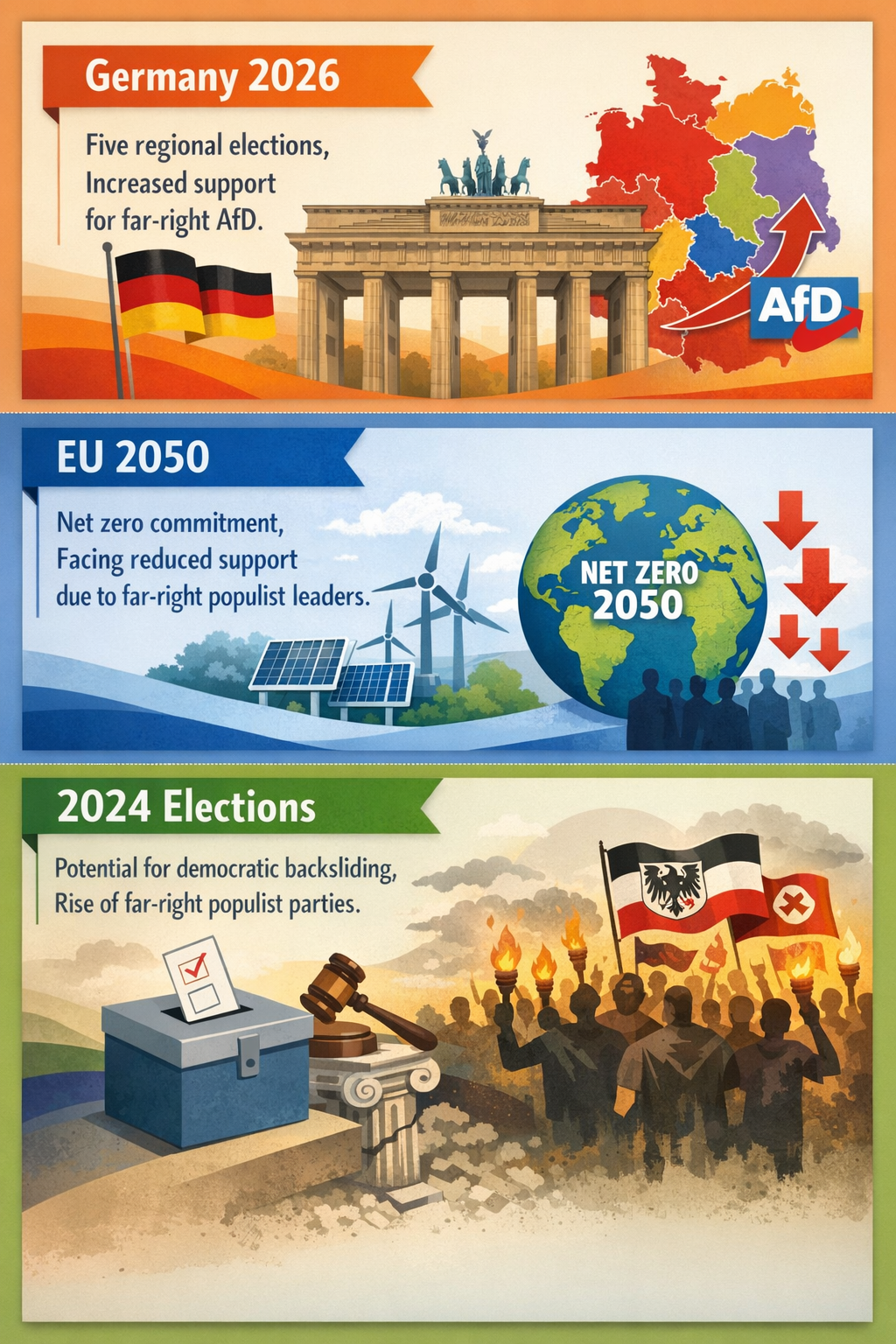
Political dissatisfaction tied to migration continues to fuel far-right electoral gains across Europe (DutchNews NL 23/04/2024), entrenching identity-driven populism as a permanent fault line rather than a cyclical political phenomenon. The European Council on Foreign Relations anticipates further support surges driven by unresolved migration management tensions.
Across multiple EU contexts, the convergence of political disenchantment, cultural polarization, and institutional mistrust sparks a systemic feedback loop whereby far-right actors leverage digital platforms and civil society fractures to erode public trust in regulatory efficacy and corporate neutrality (Roar News 15/03/2026). What is novel here is the intensification of far-right narratives as a structural corrosive force penetrating organizational governance rather than remaining peripheral electoral phenomena.
Disruption Pathway
The disruption pathway begins with the far-right’s persistent antagonistic engagement targeting organizational legitimacy from societal and operational perspectives. As charities and NGOs experience fear-driven operational constraints (Third Sector 05/05/2026), these actors may reduce programmatic reach or innovate compliance mechanisms to survive, increasing overhead and blurring mission focus.
Business risk managers and investors respond by flagging far-right political influence as a novel non-financial risk affecting reputational capital and social license to operate. Regulatory bodies, pressured by insecurities around public order, may escalate surveillance and control obligations on affected sectors, including heightened transparency, due diligence, or politically sensitive compliance directives (Religion Media Centre 01/05/2026). This feedback loop can harden polarized regulatory stances and institutional distrust.
Escalation conditions include intensifying migration-related populist pressures and digital disinformation campaigns that amplify far-right narratives. Under sustained pressure, dominant governance models within both public and private sectors could fragment, favoring segmented or siloed compliance frameworks tailored to specific political risk geographies.
The structural adaptation may take the form of fragmented regulatory standards or parallel ‘trust ecosystems’ where organizations voluntarily adopt stricter internal governance to pre-empt politicized scrutiny. Capital allocation could bifurcate, privileging firms and sectors capable of managing far-right induced legitimacy risks, while marginalizing more exposed or visibly contested actors.
Why This Matters
Senior decision-makers face heightened uncertainty around the evolving interplay between political authoritarianism and governance risk. Capital providers might need to recalibrate ESG frameworks and social risk models to explicitly incorporate far-right influence as a quantifiable risk dimension.
Regulators could face calls to either intensify oversight or create tailored exemptions reflecting sectoral vulnerabilities to far-right antagonism. Supply chains connected to politically contentious sectors may experience disruptions as stakeholders impose ideological filters on sourcing and partnerships.
Competitive positioning will increasingly favor organizations adept at navigating politicized environments, capable of proactive community engagement, or innovating institutional resilience. Strategic intelligence and scenario planning must integrate this emerging inflection to anticipate liability shifts, compliance costs, and altered market dynamics.
Implications
This development might significantly reshape regulatory and industrial landscapes if far-right authoritarianism continues to erode social trust and operational legitimacy across sectors. The ongoing normalization of politically motivated threats within civil society and business environments could catalyze the institutionalization of far-right risk as a core dimension in governance regimes.
It is unlikely that this is merely cyclical political noise or confined to electoral volatility; instead, it indicates a deeper structural recalibration of how organizations organize risk and manage stakeholder legitimacy over the next two decades.
Competing interpretations might downplay the far-right’s systemic impact, attributing disruptions to short-term political turbulence or rebalancing migration policies. However, the reinforcing dynamics between political disenchantment, institutional mistrust, and operational disruption lend credence to more profound and durable change.
Early Indicators to Monitor
- Frequency and scale of politically motivated disruptions reported by nonprofits and corporate entities.
- Regulatory consultations or draft frameworks explicitly addressing far-right political risk or ideological extremism in compliance regimes.
- Clustering of venture or philanthropic capital into organizations specifically focused on resilience against far-right legitimacy risks.
- Shifts in insurance underwriting policies reflecting increased coverage denials or premiums tied to politically motivated operational risks.
- Emergence of industry coalitions or standard bodies addressing political extremism as a governance challenge.
Disconfirming Signals
- Significant de-escalation or fragmentation of far-right political movements without sustained institutional entrenchment.
- Regulatory frameworks explicitly decoupling political risk from governance and compliance requirements.
- Strong public-sector initiatives restoring trust and resilience in democratically governed institutions, moderating polarization.
- Decrease in terrorist or violent actions associated with far-right groups over multi-year periods.
- Corporations and nonprofits effectively insulating themselves from far-right interference without raising sector-wide governance costs.
Strategic Questions
- How should capital allocators incorporate far-right authoritarianism as a material risk in ESG and social risk scoring frameworks?
- What governance innovations or regulatory adaptations could mitigate legitimacy risks stemming from political polarization in key sectors?
Keywords
far-right authoritarianism; political risk; corporate governance; regulatory frameworks; nonprofit sector; terrorism; capital allocation; ESG risk; social licence; governance innovation
Bibliography
- More than half of respondents saw the rise in far-right authoritarianism as representing an existential threat to their organizations. Third Sector. Published 05/05/2026.
- The UK has been experiencing a gradual increase in terrorist threats for some time, driven by a rise in both Islamist and extreme right-wing terrorism. Religion Media Centre. Published 01/05/2026.
- A growing trend in Europe in recent years expected to continue is the continuous rise of far-right populism. Roar News. Published 15/03/2026.
- The European Council on Foreign Relations (ECFR), a think tank headquartered in Berlin, anticipates a massive surge in support for the far right, powered by European public dissatisfaction with the latest wave of illegal immigration. DutchNews NL. Published 23/04/2024.
- Fear and Culture Wars Holding Charities Back in Responding to Far Right Threats, Report Suggests. Third Sector. Published 05/05/2026.