
Invisible Skill Shifts: The Silent Reconfiguration of Knowledge Work in the Era of Virtual Assistants and Hybrid Models
Emerging shifts in workforce skill demands, driven by the nuanced integration of virtual assistant roles and hybrid work cybersecurity complexities, are quietly reshaping industrial structures and capital flows. Despite headline attention to automation and AI substitution, a subtler, systemic redefinition of critical labor skills linked to remote operational security and service orchestration is unfolding. This reconfiguration may recalibrate competitive advantage, regulatory priorities, and organizational design over the next decade.
This insight paper examines an under-recognized weak signal within the Future of Work discourse: the intersection of burgeoning virtual assistant career paths with escalating remote work cybersecurity vulnerabilities amid hybrid labor models. Often overshadowed by broader AI automation narratives, this dynamic portends structural shifts in talent development priorities, capital allocation in cybersecurity investments, and regulatory frameworks targeting data integrity and identity protection in distributed environments. Understanding this signal is crucial for anticipating evolutions in labor market composition and organizational governance between 2026 and 2035.
Signal Identification
This development qualifies as a weak signal emerging from the intersection of disparate yet convergent workforce and cybersecurity trends with a medium to high plausibility band over a 5–10 year horizon. It is weak because it is not widely spotlighted in mainstream Future of Work analyses, which focus primarily on automation substitution or hybrid work logistics rather than the discrete skills and risk vectors in remote labor orchestration. The shift is emerging as virtual assistance careers become more accessible (GTeams 19/01/2026), while remote cybersecurity threats linked to identity abuse and session compromise rise sharply (DeepStrike 10/01/2026). Sectors exposed include information technology, professional services, regulatory governance, financial services, and HR outsourcing domains.
What Is Changing
Multiple referenced developments articulate a landscape where virtual assistant roles are expanding as practical remote careers, enabled by persistent hybrid work patterns stabilized at approximately 1.27 work-from-home days weekly globally (WishUp 15/02/2026). This growing remote workforce layer facilitates granular service and operational support beyond traditional office boundaries (GTeams 19/01/2026). However, this expansion strains existing cybersecurity postures, as remote access misconfigurations and identity abuse become dominant threat vectors in distributed work environments (DeepStrike 10/01/2026).
A recurring structural theme emerges around the fragmentation and specialization of workforce skills at the intersection of operational support, cyber risk management, and digital trust frameworks. Rather than a singular focus on AI replacing jobs, this indicates a reallocation within knowledge work toward hybridized skill sets involving cyber hygiene, session management, and identity safeguarding blended with client-facing service roles.
Additionally, a projected global skills gap approaching 40% by 2027 (NU.edu 21/01/2026) disproportionately affects roles requiring nuanced digital-physical coordination. This underscores the insufficiency of classical workforce upskilling initiatives that overlook this hybrid competency space critical for managing increasingly hybrid operational environments (Upflex 05/02/2026).
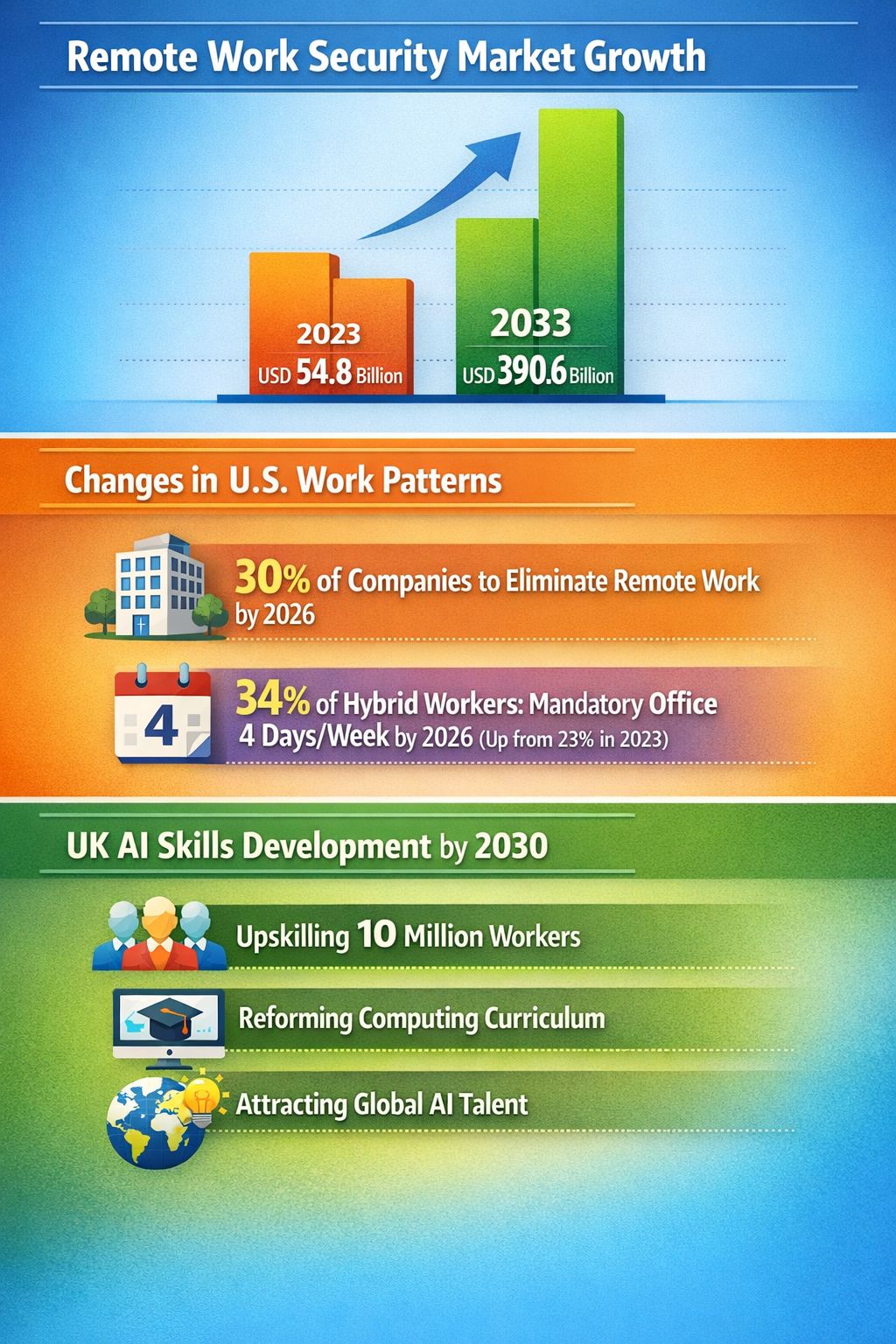
Finally, attempts by organizations to revert to traditional ‘coffee badging’ or Return to Office (RTO) mandates ignore the productive and strategic advantages cultivated through distributed, security-savvy virtual roles in business continuity and talent retention (Forbes 19/01/2026). This misalignment suggests a lag in institutional adaptation to the emergent skill and risk regime surrounding hybrid virtual workforces.
Disruption Pathway
As virtual assistant roles proliferate within hybrid workforces, demand for specialized cyber risk mitigation skills—particularly for identity and session management—may accelerate due to escalating cybersecurity incidents affecting remote operations. Rising incidences of phishing, multi-factor authentication (MFA) bypass, and endpoint compromise could increase organizational losses and reputational damage, catalyzing heightened investments in cybersecurity workforce capabilities specific to the virtual assistant and distributed labor domain (DeepStrike 10/01/2026).
This pressure exposes legacy IT architectures and regulatory frameworks that inadequately cover hybrid, often outsourced, service layers, creating systemic stress points. Organizations may adapt by co-designing new talent pipelines combining hybrid operational competence with embedded cybersecurity awareness, fostering a workforce ecosystem where service delivery and digital trust are inseparable.
Such adaptation could trigger regulatory evolution emphasizing certification standards for remote work cybersecurity competencies, affecting hiring and capital allocation. This could funnel investment toward skills development platforms, tooling for identity governance in virtual roles, and compliance mechanisms addressing hybrid access vulnerabilities.
Feedback loops might arise as improved cyber competence reduces incidents, reinforcing remote hybrid models’ viability, thereby incentivizing further role specialization and investment. Conversely, failure to upgrade skills standards may amplify security breaches, eroding trust and triggering regulatory clampdowns or market repositioning favoring integrated cyber-secure infrastructures over legacy operational silos.
Consequently, the dominant industrial model of generalized knowledge work may bifurcate into differentiated strata defined by security-aware operational specialization, reshaping labor market segmentation and enterprise governance models.
Why This Matters
From a capital allocation perspective, investors may need to pivot toward cybersecurity talent development, identity management solutions, and hybrid work infrastructure rather than focusing solely on AI-driven automation platforms. Regulatory bodies could confront rising demand to codify cybersecurity skill certifications as a prerequisite for workforce deployment in critical virtual roles, with implications for labor standards and compliance regimes.
For industries heavily reliant on distributed service models—financial services, professional services, technology vendors—this signal highlights a strategic pivot point where talent supply chain risk becomes equivalent to technological risk. Failure to integrate hybrid cybersecurity skills into operational design could expose liabilities and competitive disadvantages.
Moreover, governance frameworks may evolve to require transparent demonstration of hybrid workforce cyber competence, influencing contract structures, outsourcing arrangements, and cross-sector collaboration on standards. This may disrupt traditional industrial structures that vest control in technology solutions rather than workforce skills and processes.
Implications
The identified development could plausibly scale from a niche labor market adjustment to a structural redefinition of future work skill architecture. Organizations may increasingly value hybrid cybersecurity-operational roles, which might challenge conventional job classifications and compensation models.
This is likely to push capital flows towards both education/training providers specializing in hybrid cyber-operational competence and cybersecurity vendors integrating workforce risk management tools. Regulatory frameworks might expand to encompass workforce skills verification as a core element of cybersecurity compliance.
However, this signal should not be conflated with generic AI job displacement or hybrid work hype. Instead, it focuses on a fine-grained capability shift with systemic ramifications.
Competing interpretations could argue that technological solutions—like AI-driven security automation—may supplant the need for deep hybrid workforce skill specialization, thus limiting structural impact. Conversely, escalating cyber risk exposure in distributed environments might render automation insufficient without foundational workforce competence, bolstering this signal’s relevance.
Early Indicators to Monitor
- Growth in job postings and training programs explicitly combining virtual assistant roles with cybersecurity responsibilities.
- Increase in venture funding rounds targeting cybersecurity tools designed for hybrid and remote workforce identity management.
- Draft regulatory standards or industry certifications for cybersecurity competencies in distributed workforces.
- Corporate capital reallocation patterns favoring cybersecurity upskilling alongside hybrid work infrastructure investments.
- Incident reports or threat intelligence highlighting identity abuse and session hijacking in virtual assistant workflows.
Disconfirming Signals
- Rapid maturation and deployment of AI-driven cybersecurity automation that effectively reduces human-related threat vectors in hybrid roles, negating need for specialized skills.
- Regulatory inertia or explicit rulings limiting the imposition of cybersecurity skill certification requirements on workforce roles.
- Employer preference shifts back toward centralized, in-office operations reducing hybrid workforce scale.
- Significant decline in cybersecurity incidents related to remote work access, diminishing urgency for workforce capability adaptations.
Strategic Questions
- How should capital deployment balance investments between technology automation and human workforce cybersecurity capability development for hybrid models?
- What regulatory levers exist or could be developed to incentivize or mandate hybrid cybersecurity competency standards across distributed labor sectors?
Keywords
Virtual Assistant; Hybrid Work; Remote Work Cybersecurity; Skills Gap; Identity Abuse; Regulatory Frameworks; Strategic Intelligence; Talent Development
Bibliography
- Starting a virtual assistant career in 2026 is a practical option for anyone looking for remote work opportunities. GTeams.ai. Published 19/01/2026.
- As hybrid work continues evolving in 2026, organizations that invest in comprehensive solutions will gain competitive advantages in talent retention and operational efficiency. Upflex. Published 05/02/2026.
- Direct answer: Remote work cybersecurity statistics for 2026 show that the biggest risks are identity abuse, phishing, SaaS exposure, endpoint compromise, session hijacking, MFA bypass, BYOD gaps, and remote access misconfiguration. DeepStrike. Published 10/01/2026.
- A 40% skills gap by 2027 is projected by the World Economic Forum. NU.edu. Published 21/01/2026.
- Coffee badging will become a relic of the past as remote work becomes a competitive perk amid RTO mandates in 2026. Forbes. Published 19/01/2026.
- Hybrid work has stabilized at 1.27 WFH days per week globally, remote work remains aspirational for talent (8% of postings drawing 35% of applications), and AI adoption is creating new layers of opportunity rather than substitution. WishUp. Published 15/02/2026.