
Invisible Infrastructures: The Latent Structural Impact of AI-Enabled Digital Twins in Immersive & Augmented Worlds
Exploring how the rapid rise of AI-augmented digital twin technology represents a non-obvious structural inflection within immersive and augmented reality ecosystems beyond visible hardware trends.
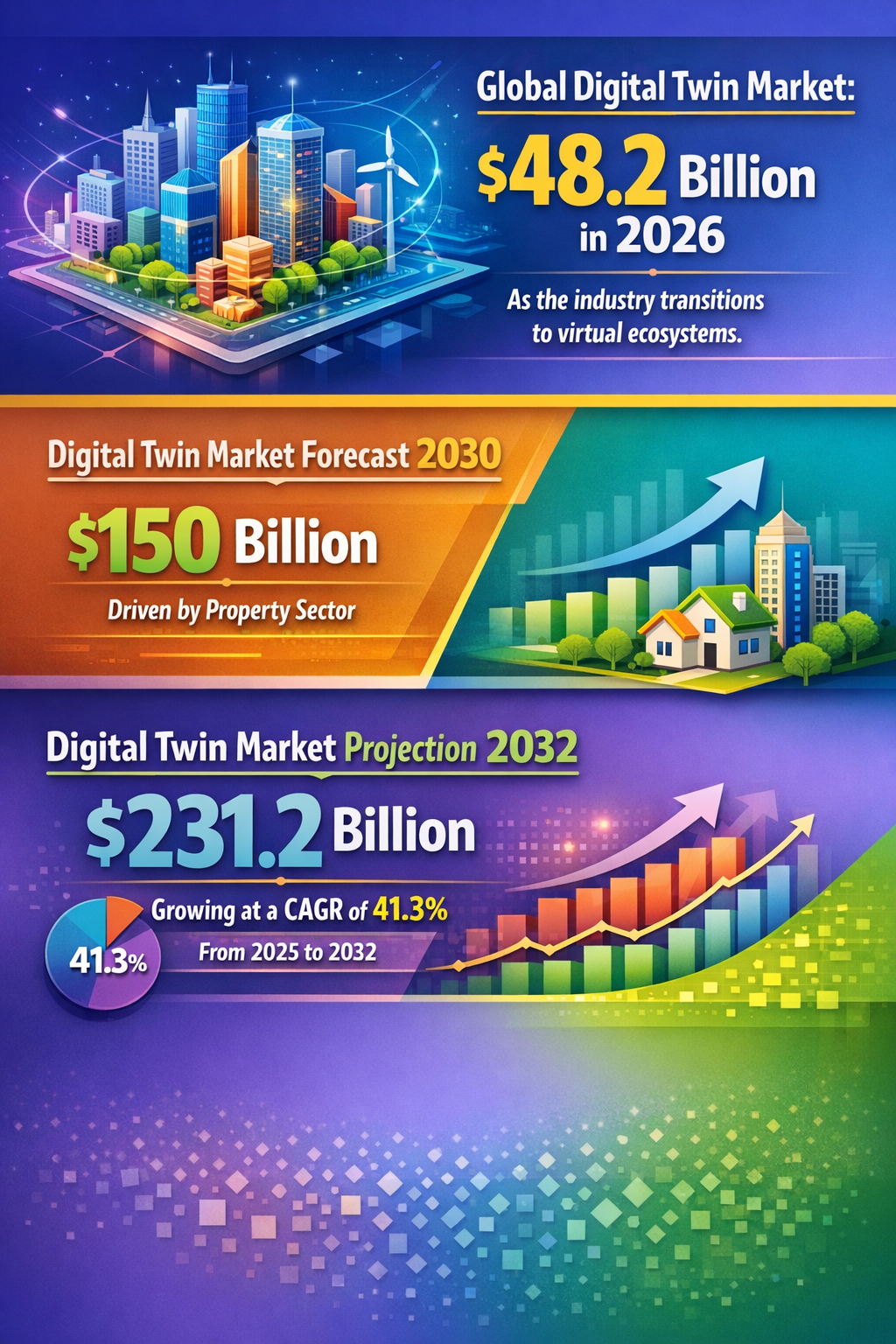
While current discourse on immersive and augmented worlds focuses heavily on hardware advances such as augmented reality (AR) glasses and near-eye displays, an underlying weak signal is emerging: the integration of AI-driven digital twin technology. With a projected compound annual growth rate (CAGR) exceeding 30% through 2035, digital twins are not merely supporting simulation but poised to underpin an invisible, systemic layer that can transform strategic capital deployment, regulatory frameworks, and industry architectures over the next 10-20 years. This signal shifts the focus away from consumer-facing hardware to the back-end, real-time, AI-powered digital replicas of physical and social realities that could scale into fundamental change.
Signal Identification
This development qualifies as an emerging inflection indicator. It is emerging because digital twin technology remains relatively under-discussed within immersive worlds compared to XR device shipments or AR glasses launches, yet it displays high-growth metrics (31.6% CAGR from 2026-2035) and increasing AI integration (Evolvance Market Research 15/05/2026). Its inflection quality lies in its potential to fundamentally alter how digital-physical interactions are modeled, managed, and regulated in immersive environments. The plausibility band is high given clear industrial investment and technological feasibility within 10-20 years. Exposed sectors include XR hardware and software, urban and recreational planning, digital infrastructure, AI governance, and regulatory regimes governing data, privacy, and liability.
What Is Changing
Most public narratives about immersive and augmented worlds highlight advancements in hardware capabilities and adoption metrics. For instance, the shipment of near-eye display units is expected to reach nearly 60 million by 2030, primarily driven by gaming and consumer AR devices (Omdia Informa Tech 01/06/2026). Similarly, companies like Snap are positioning AR glasses as the next major computing platform, reshaping user interface paradigms (NPR 19/06/2026; BBC News 15/06/2026). However, digital twin technology, defined as a virtual replica of physical assets, environments, or processes updated in real-time with AI overlays, is projected to grow faster and drive new use cases that transcend consumer entertainment or conventional XR experiences.
Digital twins are increasingly being integrated with AI to provide dynamic, predictive, and adaptive modeling capabilities in urban planning, industrial maintenance, and even recreational sectors such as indoor skydiving simulations enhanced with AI-based coaching (Verified Market Reports 10/05/2026). This fusion enables immersive worlds to evolve from static virtual environments into interconnected cyber-physical systems that can influence real-world decision-making at scale.
Crucially, this integration embeds AI into the structural backbone of immersive environments, differentiating it from visible consumer-facing applications. It serves as an invisible infrastructure that may enable entirely new forms of systemic interaction and governance, including regulatory monitoring, risk management, and industrial ecosystem orchestration. This theme is not widely recognized, as digital twins are often considered niche industrial tools rather than foundational layers for immersive worlds.
Disruption Pathway
The trajectory of AI-enabled digital twins evolving into a structural foundation for immersive and augmented worlds could accelerate under several conditions. First, continuous improvements in computational AI, sensor fidelity, and edge computing may reduce latency and increase real-time synchronization between physical entities and virtual counterparts. Second, growing urbanization and demand for smart city solutions could drive public and private investment into integrated digital twin ecosystems that combine AR spatial overlays with AI analytics, creating ‘living’ urban models.
As these infrastructures proliferate, stresses on existing regulatory and industrial models will intensify. Traditional regulatory frameworks, built for distinct physical or digital domains, may become inadequate to govern these hybrid cyber-physical systems where virtual replication impacts real-world assets and liabilities. The blurred line between physical actions and digital representations could spawn new vulnerabilities, liability gray zones, and governance dilemmas related to data sovereignty, collective safety, and ethical AI usage.
Industries may adapt by restructuring around digital twin platforms as essential infrastructure layers, much like cloud providers underpin current digital services. This could lead to vertical integration of hardware manufacturers, AI service providers, urban planners, and regulatory bodies into joint ventures or consortia. Subsequently, ecosystem governance models may shift toward hybrid public-private data trusts or multi-stakeholder AI oversight frameworks that incorporate continuous monitoring and real-time compliance enforcement within immersive environments.
Feedback loops could emerge where improved digital twin models enable more precise urban and industrial interventions, which generate richer data streams to further enhance AI models, fostering an accelerating cycle of data-driven optimization. Conversely, unintended consequences may arise from systemic overreliance on simulation fidelity, potentially introducing governance blind spots or amplifying biases entrenched in AI models.
Taken together, these dynamics could reposition digital twin-integrated immersive worlds from niche tools into foundational industrial and regulatory platforms, thereby shifting dominant industry structures and the locus of capital allocation toward invisible infrastructural layers rather than solely toward visible consumer hardware.
Why This Matters
From a decision-making perspective, investing in AI-enabled digital twin technology within immersive environments carries significant implications for capital allocation, regulatory design, and competitive strategy. Capital markets may need to rebalance funding from purely hardware-centric XR startups toward software platforms that integrate AI-driven twins and data infrastructure. Regulators will face mounting pressure to redefine frameworks around hybrid cyber-physical systems, necessitating early involvement in standard-setting for data interoperability, privacy, and liability in immersive worlds.
Companies embedded early into these invisible infrastructures may gain strategic advantages by controlling digital twin data flows and hosting regulatory compliance services, positioning themselves as indispensable ecosystem orchestrators. Supply chains may likewise transform, with hardware producers increasingly playing a secondary role to software and AI platform providers. Liability and risk governance could shift toward real-time, AI-mediated systems that monitor and enforce safety or compliance dynamically, reducing traditional post-event accountability models.
Implications
AI-enabled digital twin infrastructures could plausibly become the critical scaffolding for immersive and augmented worlds, delimiting future competitive advantage and regulatory domains. This would likely elevate the importance of data governance, AI ethics, and interoperable standards over incremental hardware improvements, fundamentally restructuring industrial ecosystems.
This development might reverse the current hype bias which focuses largely on hardware adoption metrics and flashy consumer applications. Instead, a systemic pivot toward AI-driven, real-time, and scalable digital replicas may reshape capital flows and governance, especially in urban management, recreation, and industrial sectors.
This signal is not simply an extension of current XR growth trends nor a fad driven by consumer entertainment. It is a potential paradigm shift layering AI and digital twin capabilities deeply into how immersive worlds operate and interact with real environments.
Competing interpretations might argue the complexity and cost of full-scale digital twin integration limit broad applicability or that hardware usability challenges remain paramount. Nonetheless, ignoring this infrastructural evolution risks delayed adaptation to a system-level disruption in immersive ecosystems.
Early Indicators to Monitor
- Rising patent filings and venture capital investments in AI-driven digital twin platforms targeting urban and industrial XR applications
- Emergence of multi-stakeholder standards bodies or regulatory working groups addressing digital twin interoperability and governance in immersive contexts
- Strategic partnerships between XR hardware manufacturers and AI/data infrastructure companies integrating digital twin capabilities
- Public-sector pilot projects deploying AI-enabled digital twins in smart city or recreational urban environments
- Proliferation of AI-based virtual coaching and simulation overlays in niche immersive recreational markets (e.g., indoor skydiving) reflecting early-stage ecosystem adoption
Disconfirming Signals
- Persistently high latency or cost barriers preventing real-time synchronization of digital twins with physical world data
- Regulatory backlash or judicial rulings severely restricting AI integration or data sharing in immersive worlds
- Failure of major digital twin projects or ecosystems due to lack of stakeholder cooperation or data interoperability
- Continued dominance of consumer-focused XR hardware innovations overshadowing infrastructural platform builds
- Public rejection of pervasive digital surveillance or AI-driven urban modeling efforts, stalling adoption
Strategic Questions
- How should capital allocation strategies evolve to balance investments between visible XR hardware and invisible digital twin infrastructures?
- What regulatory frameworks are needed today to pre-emptively govern AI-enhanced digital twins in immersive environments before systemic risks crystallize?
Keywords
Augmented Reality; Extended Reality; Digital Twins; Artificial Intelligence; Smart Cities; Regulatory Frameworks; Capital Allocation; Invisible Infrastructure
Bibliography
- Snap, the company behind Snapchat, is betting that augmented reality glasses could become the next major computing device. NPR. Published 19/06/2026.
- The new augmented reality (AR) glasses, called Specs, will allow users to see digital elements overlaid onto the world. BBC News. Published 15/06/2026.
- Near-eye display shipments, mostly adopted in wearable XR (extended reality) devices such as VR headsets and AR smartglasses, will be rising in the coming years and reach near 60 million by 2030. Omdia Informa Tech. Published 01/06/2026.
- Digital Twin Technology is the highest-growth segment at 31.6% CAGR from 2026 to 2035. Evolvance Market Research. Published 15/05/2026.
- Future growth will be driven by technological integration, such as virtual reality overlays and AI-based flight coaching, alongside strategic expansion into underserved urban markets and emerging recreational hubs in Canada and Mexico. Verified Market Reports. Published 10/05/2026.