
Selective Multilateralism: A Silent Inflection Reshaping Global Governance and Capital Flows
This insight paper explores the emerging and underappreciated inflection in international institutional governance driven by the rise of selective multilateralism, primarily exemplified by China’s strategic engagement. This dynamic could fundamentally recalibrate capital allocation, regulatory frameworks, and industrial strategies within the next 5–20 years.
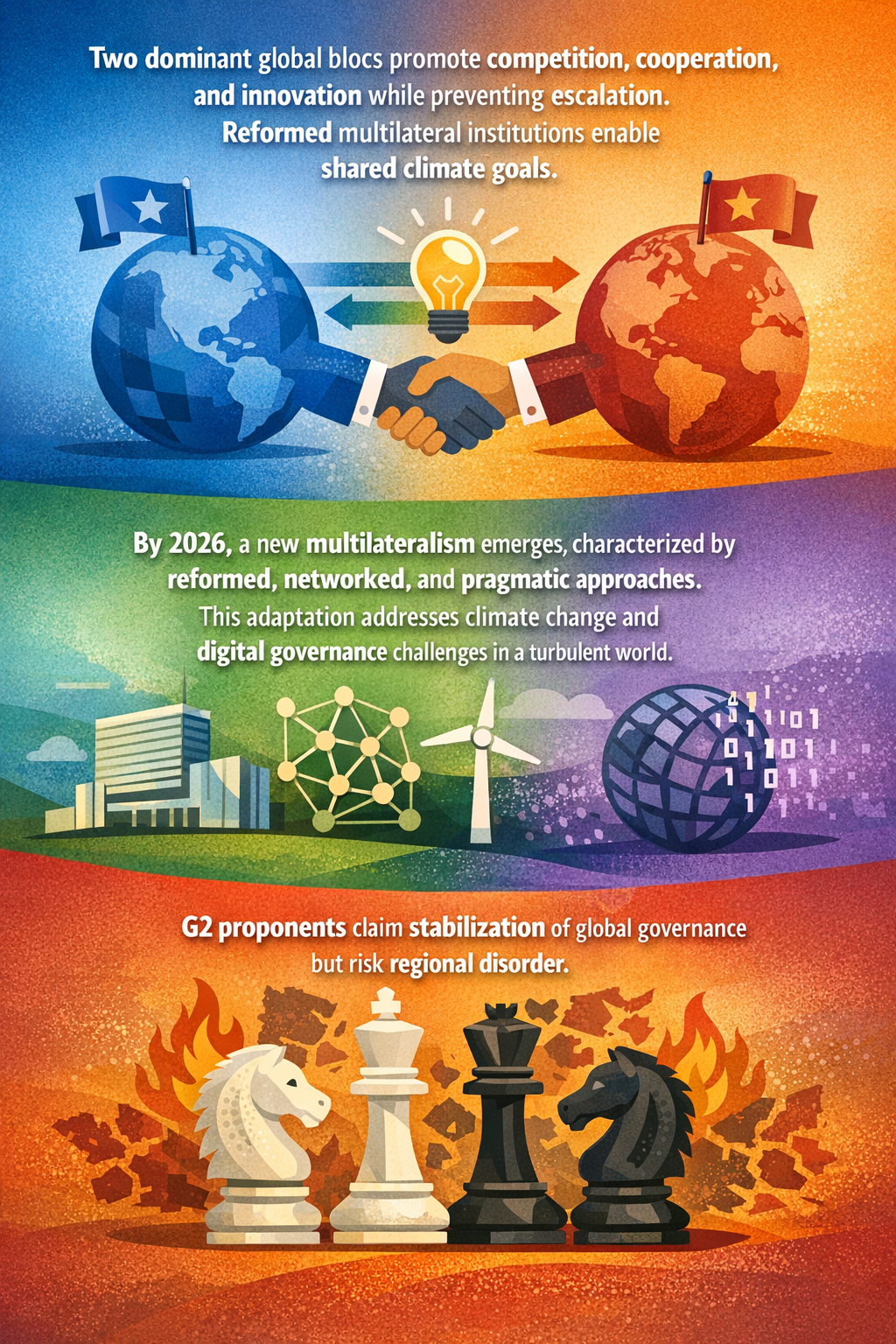
While widespread discourse focuses on overt geopolitical rivalry or fragmentation in global governance, an incipient but discreet pattern involves powerful states engaging selectively with multilateral institutions to both legitimize their influence and simultaneously reshape global rules to suit national interests. This strategic selectivity undermines traditional multilateralism’s constraint on great-power competition and risks institutional fracturing with cascading effects across trade, climate, and security frameworks.
Signal Identification
This development qualifies as an emerging inflection indicator because it reflects an ongoing and accelerating shift in how major powers engage with multilateral governance structures—moving from cooperative alignment toward strategic, selective engagement that serves competitive national agendas. Its subtlety lies in being less about outright rejection and more about deliberate partial adherence and normative reinterpretation within institutions. The horizon is medium to long-term (5–20 years), with a high plausibility band, given China’s current behavior patterns and the measurable responses in global governance forums.
Key sectors exposed include international trade regulation, climate governance and decarbonization policy, security alliances, and emerging technology industrial policy. The signal is under-recognized because mainstream analysis often frames these as zero-sum rivalry or decoupling trends, while sidelining the hybrid institutional strategy now unfolding.
What Is Changing
China’s pattern of supporting multilateral institutions—such as the United Nations (U.N.) and Shanghai Cooperation Organization (SCO)—while adhering selectively to their norms risks transforming these bodies from venues of rule-based constraint into arenas of great-power competition (MERICS 21/07/2026; The Diplomat 15/07/2026). This selective multilateralism disables classical constraints on unilateral behavior while maintaining a veneer of legitimacy, enabling structural shifts in governance without overt institutional breakdown.
Simultaneously, responses in domains like the European Union’s (E.U.) industrial policy reveal fault lines. The proposed ‘Union origin or equivalent’ content rules under the Industrial Accelerator Act embed protectionism framed as decarbonization support but risk inflating costs, delaying green transitions, and provoking World Trade Organization (WTO) disputes and retaliation (Bruegel 14/02/2026). This illustrates how selective adherence to rules extends beyond diplomacy into trade and climate policy, as regulatory frameworks leverage institutionally ambivalent mandates to embed industrial and geopolitical objectives.
Furthermore, despite recent backlash against globalization, the political benefit of extensive cross-border actor interactions underpinning global governance remains invaluable (Carnegie Endowment 05/06/2026). This persistence underscores how selective multilateralism selectively preserves connectivity to maintain influence while recalibrating rule adherence to suit strategic competition, a systemically novel governance dynamic that challenges assumptions about globalization’s demise.
Collectively, these developments highlight a substantive structural theme: the instrumentalization of multilateral institutions as platforms for managed rivalry rather than cooperation, enabled by selective compliance with global rules. This subtle institutional recalibration is insufficiently recognized as a governance inflection with potentially transformative implications.
Disruption Pathway
This signal may evolve into a structural change through the gradual normalization of selective multilateralism as a dominant global governance mode. Initially, conditions accelerating this include intensified great-power competition, especially between China and the U.S., where cooperation is both strategically necessary and politically fraught. Institutional ambiguity allows powerful states to selectively comply, reinforcing advantage while undermining rule enforcement.
As this dynamic escalates, it stresses existing systems by increasing institutional complexity and unpredictability, complicating enforcement and dispute resolution mechanisms. Traders, regulators, and alliance systems will face higher costs of compliance verification, regulatory arbitrage, and policy uncertainty.
Structural adaptation can manifest in fragmented governance blocs with overlapping but asymmetric rules and enforcement regimes. For example, regional trade and industrial policies may increasingly diverge or impose contingent rules linked to geopolitical alignments or strategic sectors, as observed in E.U. decarbonization subsidies and origin rules.
This may trigger feedback loops—norm erosion encourages more selective adherence, weakening global rule legitimacy and incentivizing parallel institution-building with tailored norms. This dynamic could catalyze a multipolar ‘nested’ governance architecture with competing institutional logics rather than a universal rulebook, a fundamental paradigm shift.
Under these conditions, dominant governance models may shift from a shared global rules-based order toward a hybrid model of selective multilateralism, hybrid normative regimes, and conditional cooperation aligned to geopolitical interest rather than universal principles.
Why This Matters
For senior decision-makers, recognizing this emerging inflection is critical for anticipating how rules and governance frameworks affecting capital allocation, regulatory compliance, and industrial strategy will evolve. Capital deployed in global trade, technology, and decarbonization sectors may face bifurcated regulatory regimes depending on geopolitical alignment and institutional interpretation.
Regulatory frameworks could fragment, imposing additional costs and risks on firms navigating divergent compliance expectations, potentially reshaping global supply chains with increased regionalization and strategic localization. Industrial strategy will be influenced by contingent subsidies and trade conditions reflecting selective governance adherence.
Strategic positioning must incorporate an understanding of selective multilateralism as a structural element shaping international competition and cooperation, rather than transitory geopolitical friction. Failure to anticipate this could result in misaligned investments, regulatory surprises, and vulnerability to shifting alliance and institutional dynamics.
Implications
This development could likely lead to a reconfiguration of global governance where the formerly clear boundaries between cooperation and competition blur, necessitating more sophisticated scenario planning and risk governance. Capital allocation might increasingly favor actors and sectors aligned with dominant governance blocs or flexible enough to navigate fragmented regimes.
Governments could face policy tradeoffs between protecting domestic interests and preserving international institutional legitimacy, possibly triggering reciprocal policy escalations in trade, technology, and green industrial policies. Supply chains and digital infrastructure may regionalize more rapidly than previously anticipated, driven not just by decoupling but by selective institutional logic.
This should not be confused with an outright collapse of globalization or global governance; the signal points to a hybrid, adaptive governance complex that preserves connectivity yet operationalizes strategic selectivity— a nuance often overlooked.
Competing interpretations might view these developments as either a temporary strategic posture or a definitive paradigm shift; the evidence suggests a deeper structural recalibration rather than transient policy posturing.
Early Indicators to Monitor
- Changes in official positions and voting patterns within key multilateral institutions such as the U.N., the WTO, and the SCO reflecting selective compliance or reinterpretation of rules.
- Emergence and expansion of regional and plurilateral institutional initiatives bypassing or redefining global governance norms.
- Legislative and regulatory drafts embedding content or origin restrictions tied to geo-industrial strategy, e.g., in decarbonization subsidies or critical technology supply chains.
- Clusters of strategic venture funding and procurement shifts favoring technologies and supply chains aligned with distinct governance blocs or hybrid institutional logics.
- Formal WTO dispute filings and trade retaliation linked to industrial support measures framed as climate or green subsidies.
Disconfirming Signals
- Strong, coherent enforcement of global rules by multilateral institutions leading to consistent compliance and dispute resolution.
- Explicit multilateral agreements that address selective adherence through institutional reform or monitoring mechanisms.
- A decisive realignment or détente between great powers reducing incentives for selective institutional engagement.
- Broad, bipartisan domestic political consensus in key states prioritizing strict multilateral rule adherence.
- Significant reversal or abandonment of geo-industrial content rules that trigger widespread trade retaliation or WTO rulings.
Strategic Questions
- How can capital deployment strategies adapt to navigate and hedge risks created by fragmenting regulatory and governance regimes driven by selective multilateralism?
- What governance reforms or alliance-building initiatives might counterbalance or channel selective adherence into constructive, sustainable institutional adaptations?
Keywords
Selective Multilateralism; China Global Governance; Industrial Policy Decarbonization; Global Trade Fragmentation; World Trade Organization; Governance Reform; Geo-Industrial Strategy; Multilateral Institutions
Bibliography
- China may support the UN, the SCO and other multilateral institutions, but its selective adherence to common rules risks turning its multilateralism into a vehicle to compete with US rather than constraining great-power rivalry. MERICS. Published 21/07/2026.
- China may support the U.N., the SCO and other multilateral institutions, but its selective adherence to common rules risks turning its multilateralism into a vehicle to compete with United States rather than constraining great-power rivalry. The Diplomat. Published 15/07/2026.
- The 'Union origin or equivalent' content rules in support schemes risk delaying decarbonization, inflating costs for consumers and firms, and inviting third-country WTO challenges or retaliation. Bruegel. Published 14/02/2026.
- Despite backlash against globalization, its political benefits-extensive cross-border connections among a multiplicity of actors - are a fundamental part of global governance in this century and will remain an essential element in any future architecture. Carnegie Endowment. Published 05/06/2026.
- Union origin content rules as a trigger for WTO disputes and their potential economic impact. World Trade Organization. Published 23/10/2025.