
Invisible Crypto Intent Protocols: The Under-Recognized Inflection in Tokenised & Decentralised Finance
Emerging crypto intent protocols promise to make blockchain transactions effectively invisible to end users, signaling a potential paradigm shift in decentralised finance (DeFi) infrastructure. This development could reshape capital flows, regulatory approaches, and industrial strategies by embedding DeFi into mainstream consumer applications.
This paper identifies the near-invisible integration of crypto intent protocols as an emerging inflection that remains underappreciated outside niche technical circles. Unlike the commonly discussed tokenisation of real-world assets or stablecoin adoption, this signal focuses on how seamless user interaction will catalyse mass-market financial infrastructure transformation over the next decade. Understanding this shift will better prepare decision-makers for structural changes in financial system design, governance, and competitive positioning.
Signal Identification
The trend of crypto intent protocols achieving invisible blockchain interactions qualifies as an emerging inflection indicator. This marker indicates a system-level evolution that moves DeFi and tokenised finance from isolated tech-enabled niches toward embedded mainstream consumer platforms, thereby altering user experience, governance, and regulatory paradigms substantially.
Its plausible time horizon is 5–10 years, with a high likelihood given current adoption trajectories and ongoing technological refinement (Blocsys 01/12/2023). Key sectors exposed include capital markets infrastructure, consumer finance, payment systems, cybersecurity, and regulatory oversight.
What Is Changing
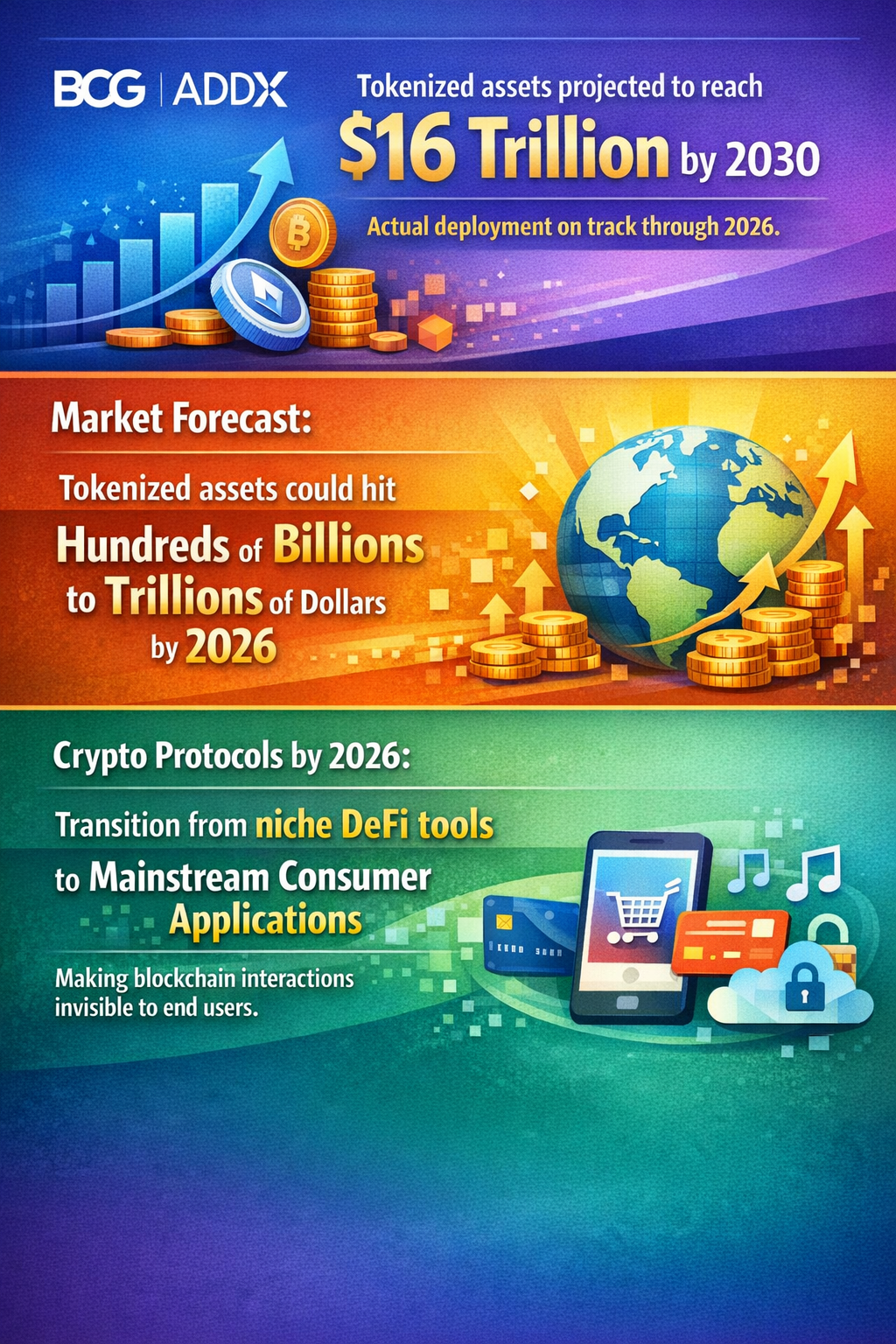
Several concurrent developments signal a substantive infrastructure transformation underpinning decentralised finance. Tokenised assets are projected to reach $16 trillion by 2030, supported by accelerating real-world asset tokenisation that already aligns with early deployment trends (Yellow Research 22/11/2023). While this trajectory showcases capital mobilisation, the user interface remains a critical bottleneck for mass-market engagement.
Crypto intent protocols address this by abstracting blockchain complexities away from users, effectively rendering blockchain interactions invisible at scale (Blocsys 01/12/2023). This differs from DeFi tooling's previous emphasis on user adoption through explicit interface interactions, shifting instead to intent-driven, contextually embedded financial execution within broader digital ecosystems.
Simultaneously, the rise of digital asset integration into traditional finance underscores increasing cybersecurity and regulatory scrutiny, evident from dedicated US financial market channels for cyber-threat information sharing in crypto (Finextra 15/11/2023). The confluence of these trends signals systemic shifts towards a hybrid, layered ecosystem balancing decentralisation with institutional-grade governance.
Moreover, regulatory bodies such as the US Securities and Exchange Commission (SEC) are recalibrating enforcement priorities to include digital assets alongside AI and cybersecurity risks (IQ-EQ 10/11/2023), demonstrating regulatory awareness of evolving financial interfaces enabled by underlying technological protocols.
Disruption Pathway
The trajectory toward invisible crypto intent protocols may escalate through accelerating demand for user-friendly DeFi experiences that seamlessly integrate into non-crypto-native consumer applications (e.g., social media, e-commerce platforms). Market-facing conditions accelerating adoption include growing institutional tokenised asset holdings and mounting pressure on legacy financial intermediaries to innovate (CoinStats 05/12/2023).
Invisible protocols will strain existing regulatory frameworks that remain predicated on identifiable intermediaries and explicit transaction endpoints. This diffusion challenges enforcement visibility and introduces governance stress—particularly in safeguarding consumer protections amidst rapid, automated financial intents.
Structural adaptations may include new layered governance models, hybrid custodial architectures, and regulatory frameworks embedding continuous cyber threat intelligence sharing (Finextra 15/11/2023). Additionally, financial services firms may pivot toward ecosystem orchestration roles rather than bilateral market-making.
Feedback loops fueling expansion include network effects from user-centric interfaces that normalize DeFi usage while compelling regulators and incumbents to develop interoperable standards and compliance technologies. However, unintended consequences such as systemic cyber risk concentration and new forms of market opacity are probable, requiring vigilant governance innovation.
Given these dynamics, dominant models could shift toward hybrid decentralised-centralised frameworks that reconcile seamless user experiences with traceability and compliance, fundamentally transforming industrial positioning.
Why This Matters
For capital allocators, this signals the necessity to reposition investment strategies toward ecosystem-layer infrastructure providers enabling seamless DeFi integration rather than isolated token projects alone. Regulatory bodies face imperative to update frameworks that encompass invisibly embedded financial intents, balancing innovation enablement with robust consumer and systemic protections.
Competitive positioning in financial services will increasingly depend on mastering embedded DeFi orchestration and compliance within mainstream digital platforms, recasting traditional roles in capital markets and payments. Supply chains for financial technology and cybersecurity will need to realign to address this invisibility in blockchain execution and evolving attack vectors (MetaMask 18/11/2023).
Liability models could shift toward joint responsibilities across technology providers, platform hosts, and regulators. Governance consequences include new collective action frameworks and cross-sector intelligence sharing focusing not only on asset tokens but also underlying intent protocols.
Implications
Invisible crypto intent protocols could structurally change how capital is allocated by enabling decentralized finance to embed into everyday consumer transactions, thereby expanding DeFi’s addressable market beyond the crypto-native audience. This development might transform regulatory approaches from static transaction monitoring toward dynamic intent and risk pattern detection.
It is unlikely that this signal is mere incremental techno-optimism; instead, it may precipitate a structural realignment of finance, digital identity, and consent architectures. However, this development is not equivalent to a wholesale shift to full decentralization; rather, it enables a new hybrid layer where decentralised infrastructure is masked for mass adoption while controls exist behind the scenes.
Competing interpretations could downplay this as mere UX evolution or anticipate slower regulatory adaptation, but the layering of current trajectories across ecosystem, regulatory, and risk dimensions suggests otherwise.
Early Indicators to Monitor
- Surge in venture funding toward user-intent abstraction middleware and API-based crypto finance integration tools
- Formation of cross-industry standards around intent representation and execution in blockchain context
- Increased regulatory guidance or pilot frameworks addressing invisible, embedded DeFi transactions
- Proliferation of consumer apps featuring seamless DeFi-enabled financial services without explicit blockchain interfaces
- Growth in cyber intelligence sharing initiatives tailored to advanced DeFi protocol vulnerabilities
Disconfirming Signals
- Prolonged failure to achieve mainstream consumer adoption of intent-driven DeFi interfaces despite technical feasibility
- Regulatory clampdowns that enforce explicit, transparent blockchain interaction requirements, curtailing invisibility
- Major cybersecurity breaches tied to invisible transaction protocols leading to reputational or systemic damage
- Stagnation or reversal of institutional capital deployment into tokenised assets due to market or macroeconomic headwinds
Strategic Questions
- How should capital allocation shift toward ecosystem infrastructure enabling invisible DeFi experiences within conventional digital products?
- What regulatory frameworks and governance models are required to oversee effectively decentralised but user-invisible financial intents?
Keywords
Tokenised Assets; Decentralised Finance; Crypto Intent Protocols; Financial Regulation; Cybersecurity; Blockchain User Experience; Digital Assets; Regulatory Innovation
Bibliography
- Crypto intent protocols 2026 will move from niche DeFi tooling into mainstream consumer application infrastructure - making blockchain interactions effectively invisible to end users for the first time at scale. Blocsys. Published 01/12/2023.
- BCG and ADDX projected tokenized assets reaching $16 trillion by 2030 under their 2022 base case scenario, a trajectory that actual deployment data through 2026 is tracking closely. Yellow. Published 22/11/2023.
- As digital assets become more integrated into the financial system, access to timely and actionable cyber threat information is essential to protecting consumers and safeguarding the stability of U.S. financial markets. Finextra. Published 15/11/2023.
- The U.S. Securities and Exchange Commission (SEC) is refocusing on core enforcement priorities, while addressing emerging risks such as AI, cybersecurity and digital assets. IQ-EQ. Published 10/11/2023.
- Absolute TVL remains modest relative to total Bitcoin DeFi opportunity (~ $500 billion in institutional holdings). CoinStats. Published 05/12/2023.
- Smart contracts can contain bugs or exploitable vulnerabilities - the 2022 Wormhole bridge exploit, for instance, resulted in the loss of $320 million in wrapped assets. MetaMask. Published 18/11/2023.