
The Quiet Crisis in Climate Finance Risk-Sharing: A Potential Inflection in Sustainable Capital Allocation
Green and sustainable finance continues to expand rapidly, driven primarily by increasing regulatory pressure, investor demand, and climate risk awareness across global markets. Europe and North America are advancing their ESG (Environmental, Social, and Governance) capital markets, but significant structural gaps remain—in particular regarding climate finance flows to emerging markets such as India. Among these, an under-recognized development is the persistent failure of risk-sharing mechanisms between public and private actors in climate finance. This shortcoming acts as a latent constraint on private capital deployment into climate solutions for developing economies, which represent critical nodes in the global transition. If this structural weakness scales, it could fundamentally alter how capital is allocated globally, reshape regulatory approaches to financial instruments, and recalibrate partnerships between public sector entities and private investors over the next 10–20 years.
Signal Identification
This is identified as an emerging inflection indicator because it signals a potential shift in the structural organization of climate finance markets and risk governance. It has medium to high plausibility within a 10–20 year horizon, given current unresolved issues and increasing climate finance demands in emerging markets. It primarily exposes the sustainable finance, regulatory, and international development sectors, with broad implications for capital markets, institutional investors, multinational banks, and sovereign risk frameworks.
What Is Changing
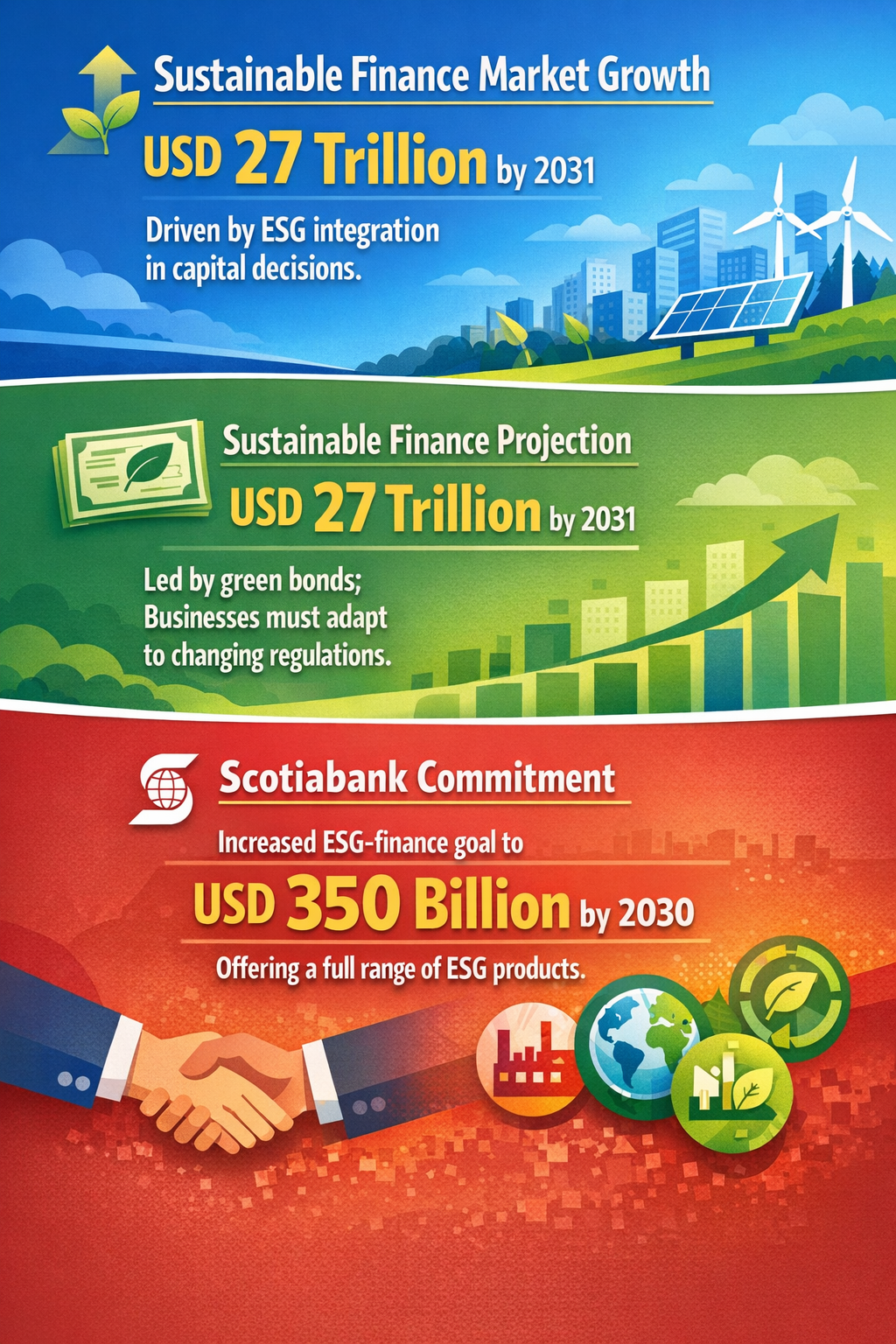
The aggregation of sustainable finance targets in North America and Europe illustrates a momentum that is largely absent across rapidly developing economies. For example, North American banks such as Scotiabank are significantly increasing their ESG finance commitments—upgrading from $100 billion to $350 billion by 2030—demonstrating robust private sector engagement in green finance products (Global Finance Award Winners 08/02/2026).
Meanwhile, Europe is positioned to maintain leadership in green bond issuance, expected to account for 42% of new issuance in 2026 (Environmental Finance 08/02/2026). This points to financially developed regions innovating and deepening sustainable capital markets with relative ease.
In stark contrast, India’s climate finance need remains acute, estimated at 6-7% of GDP annually, but public budgets cover only a small fraction of this demand. Crucially, the absence of adequate risk-sharing tools and frameworks is holding back private capital inflows, reflecting a systemic market failure (PMF IAS 08/02/2026). This gap inhibits scaling of climate investments despite the bankability of many projects and the growing availability of private ESG capital in developed markets.
This juxtaposition presents a recurring but understated theme: the asymmetry and inadequacy of risk transfer and risk mitigation structures between public policymakers/finance institutions and private investors in emerging markets. While the developed world capital markets deepen green financial product offerings, emerging economies continue to rely largely on constrained public finance without leveraging proportionate private participation.
Disruption Pathway
If this risk-sharing failure persists, it could catalyze significant adaptive changes with far-reaching impact. Initially, the stress point will manifest as a persistent shortfall in deployable private green capital for the fastest-growing, most carbon-intensive emerging economies. This will amplify funding gaps in infrastructure, renewables, and resilience projects that are critical for meeting global climate mitigation and adaptation goals.
To address these gaps, multilateral development banks (MDBs), sovereign wealth funds, and development finance institutions (DFIs) may be compelled to innovate new risk-sharing models that more effectively absorb or reallocate credit, political, and currency risks. For example, layered risk tranching in climate bonds, credit enhancement facilities, or public guarantees might become standardized components of ESG finance packages tailored for emerging markets. An escalation in these instruments could incentivize private capital participation by reducing downside exposure.
Simultaneously, regulators in developed capital markets, pressured by geopolitical and climate imperatives, may begin to mandate or incentivize climate risk-adjusted capital adequacy norms that explicitly account for geographic and market-specific risk-sharing frameworks. This could provoke structural reform in how green assets and climate risk exposure are quantified and regulated, potentially leading to differentiated capital treatment for investments in emerging versus developed markets.
In industrial terms, a new class of intermediaries—specialist risk transfer mechanisms or insurance products—may emerge as vital participants in the sustainable finance ecosystem, akin to how credit default swaps once catalyzed structured finance markets. This could reshape financial intermediation, increasing the sophistication and layer complexity of sustainable financial instruments, and altering governance models by embedding public-private risk-sharing more deeply into capital allocation processes.
Why This Matters
For decision-makers allocating capital, the risk-sharing gap signals a critical structural vulnerability in the sustainability thesis that private capital will universally fill all climate finance gaps. Without effective risk-sharing innovations, investments may become geographically skewed towards developed markets, constraining the global climate transition and further entrenching economic imbalances. This may also heighten stranded asset risks in emerging economies that cannot finance necessary transitions.
Regulators and policy makers face a complex mandate to balance risk mitigation, market stability, and climate goals. Enhancing risk-sharing frameworks requires international coordination and could challenge traditional regulatory sovereignty, especially as climate risk transcends borders. Failure to innovate on this front could lead to mispricing and misallocation of climate risk, increasing systemic financial vulnerabilities.
From a competitive perspective, banks and financial institutions able to develop or access effective risk-sharing products for emerging market ESG finance may gain privileged access to under-penetrated but high-growth sectors, improving long-term portfolio diversification and resilience. Supply chains and industrial strategies reliant on emerging market decarbonization may be indirectly impacted through financing bottlenecks or delays.
Finally, governance and liability regimes may need recalibration as public and private actors renegotiate responsibility and risk thresholds, potentially impacting fiduciary duties, due diligence requirements, and ESG disclosure standards.
Implications
This signal could plausibly usher in a more nuanced, multilateral approach to climate finance characterized by sophisticated risk-sharing and credit enhancement frameworks that better mobilize private capital in emerging economies. Capital flows may increasingly differentiate by geography and risk structures rather than by ESG rating alone.
It should not be interpreted as a failure of sustainable finance growth globally but rather as an indication that broad-brush “green capital” assumptions risk overlooking critical structural barriers. Equally, it may intensify calls for enhanced cooperation between public, private, and multilateral finance actors to create hybrid financial products that blend developmental and commercial imperatives.
Competing interpretations include optimism that growing private ESG mandates alone will solve emerging market finance gaps, or skepticism about complexity and cost of risk-sharing innovations diminishing net returns below market thresholds. However, the recurrent nature of this risk-sharing gap across reports suggests it is not transient but structural.
Early Indicators to Monitor
- Increase in issuance of blended finance instruments combining public guarantees or credit enhancements with private ESG capital.\br> - Regulatory proposals or pilot programs incorporating differential capital treatment or supervisory expectations based on geographic risk-sharing structures.\br> - Expansion of specialized climate risk insurance or derivatives linked to emerging market exposures.\br> - Growing participation of MDBs and DFIs in designing risk-sharing tools aligned with private investors’ risk appetites.\br> - Venture funding clustering around fintech and insurtech firms innovating climate risk transfer solutions.
Disconfirming Signals
- Breakthrough technologies or standardized asset frameworks that dramatically reduce risk perceptions and eliminate the need for risk-sharing instruments.\br> - Large-scale direct sovereign climate finance from emerging markets significantly increasing, reducing reliance on private capital.\br> - Regulatory retrenchment or reduced climate finance mandates in developed markets limiting private ESG finance growth internationally.\br> - Persistent increases in private capital deployment in emerging markets without development of risk-sharing tools, implying other market mechanisms resolve risk asymmetry.
Strategic Questions
- How can existing public finance institutions accelerate innovation in risk-sharing mechanisms to mobilize private capital efficiently?
- What regulatory frameworks or capital adequacy standards could be adapted to reflect nuanced climate risk in emerging markets?
- Which financial intermediaries or product innovations could materially reduce risk asymmetry and unlock capital at scale?
- How might shifts in risk governance affect competitive positioning among global banks, insurers, and asset managers?
- What role should international coordination and governance reforms play in developing these risk-sharing frameworks?
- How might this evolving risk-sharing landscape influence ESG disclosure, reporting standards, and fiduciary responsibilities?
Keywords
Climate Finance; Risk Sharing; Blended Finance; Emerging Markets; ESG; Public-Private Partnerships; Multilateral Development Banks; Capital Allocation; Financial Regulation; Sustainable Bonds.
Bibliography
- Environmental Finance 08/02/2026. “With the largest number of sustainable and responsible investors in the world, Europe will remain at the forefront of new sustainable bond issuance.”
- Global Finance Magazine 08/02/2026. “Scotiabank has more than redoubled its commitment to ESG finance, raising its goal to $350 billion by 2030.”
- PMF IAS 08/02/2026. “India needs climate finance equal to ~6-7% of GDP annually yet public budgets cover only a small fraction, with limited risk-sharing tools to crowd in private capital.”
- TradingView 08/02/2026. “Key drivers behind ESG and sustainable finance include climate change and environmental risks made financially material by regulations and climate commitments.”