
Strategic Weak Signal: The Regulatory Shift from Climate-Related Risk Disclosure to Climate-Risk Enforcement and Its Implications for Financial and Corporate Governance
While mainstream climate discourse prioritizes the physical impacts of climate change—such as rising temperatures, extreme weather events, and biodiversity loss—an under-recognized development gaining momentum is the transition in regulatory frameworks from voluntary disclosure of climate risks to active enforcement of climate-related deficiencies, signaling a potential inflection in capital allocation and industrial governance. This development is coupled with emerging stringent climate disclosure regimes that promise to embed climate risk deeply into financial decision-making and liability structures within the next decade. The implications extend beyond environmental reporting, posing a structural challenge to corporate risk governance, investor behavior, and regulatory oversight worldwide.
Signal Identification
This development qualifies as an emerging inflection indicator because it marks a shift from voluntary or guidance-focused climate risk disclosure regimes toward binding enforcement mechanisms and standardized, mandatory frameworks. The European Central Bank’s 2026 Supervisory Review and Evaluation Process (SREP) cycle signals enforcement actions targeting unresolved climate-risk deficiencies, a marked departure from remediation via voluntary compliance (JDSupra, 2024). Concurrently, California’s impending climate disclosure rules for over 4,000 large companies are expected to become a de facto national standard within the U.S. (ESG News, 2024). These regulatory signals have a plausibility band: high, with a time horizon of 5–10 years, tightly linked to financial services, corporate governance, energy, and insurance sectors, but also resonating through industrial supply chains reliant on capital markets.
What Is Changing
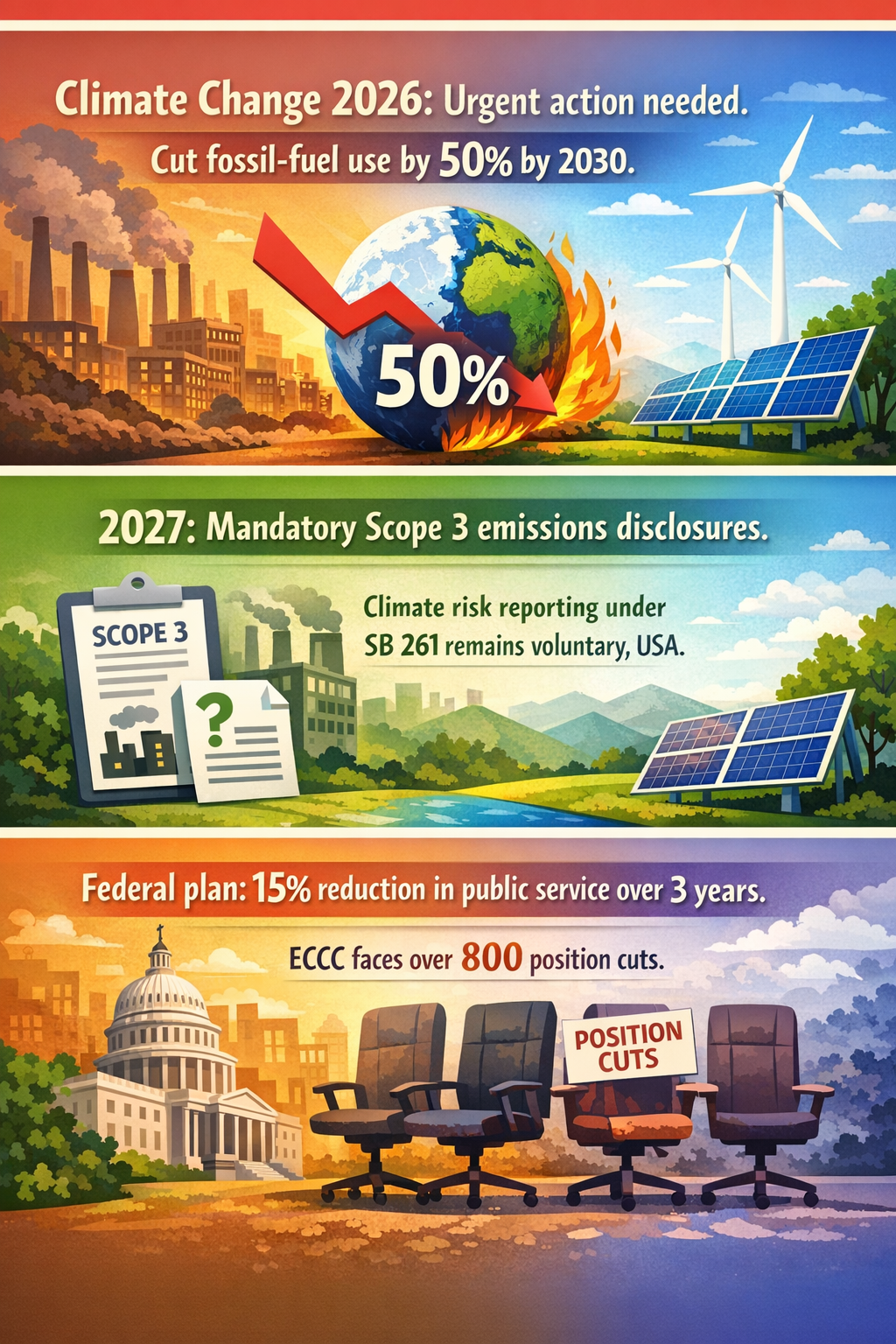
The convergence of supervisory enforcement in Europe and mandated disclosure in California reflects a move beyond the widely critiqued voluntary frameworks championed by organizations such as the Task Force on Climate-related Financial Disclosures (TCFD) (Yale SOM Insights, 2024). While voluntary disclosure drove initial awareness, the limits of self-reporting and inconsistent standards have become apparent as physical climate risks intensify, insurance premiums rise, and risk pools fracture (High Country News, 2024). Increasingly stringent regulatory architectures signal a paradigm shift in how climate-related financial risk is viewed—not as ancillary ESG compliance but as core systemic risk warranting supervisory action and liability exposure. The European Central Bank’s integration of climate-risk deficiencies into enforcement measures illustrates that unresolved risks will no longer be deferred but actively addressed with penalties or credit restrictions, challenging banks and firms to accelerate internal risk modeling, capital buffers, and climate-aligned financing (JDSupra, 2024). Meanwhile, California’s regulatory framework introduces obligations on extensive climate risk and emissions data reporting, likely pushing companies toward embedded, real-time climate risk analytics integrated into mainstream corporate financial controls and public reporting (ESG News, 2024). This regulatory seriousness challenges long-standing market assumptions that climate risk is peripheral or manageable through insurance alone, especially as insurers anticipate soaring premiums or market exit due to increasing extreme weather event frequency (Insurance Business Mag, 2024). Compounding this is a paradoxical reduction in government environmental capacity in some jurisdictions, such as Canada's 15% public service cut at Environment and Climate Change Canada, which may accelerate reliance on regulatory mandates and private sector accountability mechanisms rather than traditional policy-driven risk mitigation (Yahoo News, 2024). This dynamic introduces pressure on firms to pre-emptively manage their climate risks as regulatory enforcement frameworks evolve rapidly and public institutional support for climate adaptation declines.
Disruption Pathway
The shift toward enforcement-driven climate risk oversight initiates a cascade of structural adaptation beginning in financial intermediation. Regulatory bodies empowered to penalize unresolved climate risk deficiencies may compel banks and insurers to tighten credit and underwriting standards based on granular, forward-looking climate risk data. This escalates capital costs for carbon-intensive industries or those vulnerable to physical climate risks, likely redirecting capital flows toward firms with robust climate risk management or mitigation strategies.
As financial institutions internalize these risks under mandated frameworks, industries will experience heightened pressures to integrate climate resilience and decarbonization into core operations. This process disrupts traditional industrial structures by accelerating divestment from high-risk assets and increasing the attractiveness of technologies such as CRISPR-enhanced agriculture for productivity under climatic stress (OpenPR, 2024), innovative water management solutions amid drought and flooding threats (ABC News, 2024), and coastal defense systems countering high-impact sea-level rise risks (Nature, 2026).
The accelerated enforcement of climate risk will likely exacerbate stresses in existing governance models, particularly where climate risk is poorly integrated or acknowledged. Firms lagging in transparency or adaptation may face escalating regulatory fines, market exclusion, or litigation as standards harden and stakeholder expectations evolve. Over time, regulatory frameworks may coalesce into binding international standards, especially as U.S. states and the European Union leverage their large capital markets to impose extraterritorial compliance demands.
This could disrupt prevalent voluntary ESG frameworks, recalibrating governance from reputational management toward fiduciary duty regarding climate risk. Institutional investors may alter portfolio strategies to comply with new controls, reshaping industrial supply chains to prioritize resilience and emissions transparency. In some scenarios, this evolution may also trigger systemic shocks if entire financial sectors seize exposure to underappreciated climate liabilities, forcing government intervention or recalibration of regulatory approaches.
Why This Matters
Senior decision-makers should recognize that capital allocation strategies face potential structural reorientation driven by regulatory enforcement of climate-risk disclosures rather than voluntary reporting. Firms and financial institutions unable or unwilling to embed timely, accurate climate risk measurement into decision-making processes may face higher capital costs or regulatory sanctions.
Governments pursuing industrial policies must anticipate jurisdictional regulatory divergences converging on mandatory climate risk enforcement as a competitive baseline. This signals the necessity to harmonize rules to prevent regulatory arbitrage and supply chain fragmentation.
For corporate governance, climate risk is fast becoming a core fiduciary concern with direct implications for liability. Boards and risk committees could face amplified scrutiny regarding preparedness, potentially exposing directors and officers to litigation if deemed negligent in managing enforced climate-related risk obligations.
Supply chains may witness reconfiguration toward suppliers demonstrating climate risk resilience and transparency to maintain access to capital and insurance coverage, especially in high-risk geographies vulnerable to extreme weather and sea-level rise.
Implications
This enforcement trend may lead to a structural shift in how climate risk is integrated across market and regulatory systems. It is likely to accelerate the decarbonization of capital portfolios, induce higher capital and insurance costs for vulnerable sectors, and increase the costs and complexity of compliance for firms globally.
Though this signal does not guarantee uniform regulatory adoption or immediate global standardization, it reflects a directional pivot away from permissive disclosure toward mandatory, enforced accountability. It might slow voluntary ESG initiatives as companies await clear regulatory parameters; conversely, it could also prompt preemptive corporate transformations to avoid punitive measures.
It is not a transient reporting upgrade but a fundamental realignment of risk governance, potentially influencing industrial competition, cross-border investment flows, and systemic financial stability within 5–10 years.
Competing interpretations may view the shift as regulatory overreach or bureaucratic burden rather than systemic opportunity, potentially leading to resistance or regulatory backlash in specific jurisdictions. However, initial enforcement signals from major global financial centers indicate rising momentum.
Early Indicators to Monitor
- Publication of enforcement guidelines and actions during the ECB 2026 SREP cycle targeting climate-risk deficiencies.
- Uptake and compliance levels with California’s mandatory climate disclosure rules post-2026, and whether other states or federal regulators adopt similar regimes.
- Financial sector adjustments reflecting increased capital costs or credit tightening tied explicitly to enforced climate risk metrics.
- Litigation cases linking corporate officers’ fiduciary duties to climate risk management failures.
- Accelerated corporate patenting and investment in climate risk analytics, resilience technologies, and climate-aligned asset classes.
- Expansion or formalization of international climate risk regulatory cooperation forums or standards bodies.
Disconfirming Signals
- Delay, dilution, or suspension of planned enforcement frameworks by major regulators due to political backlash.
- Evidence of persistent voluntary climate disclosure frameworks maintaining dominance without enforcement escalation.
- Significant government reinvestment in environment agencies countering the reliance on private sector enforcement.
- Financial sector-wide pushback resulting in lack of capital repricing or climate risk integration despite regulatory signals.
- Emergence of new voluntary disclosure initiatives that gain traction and stall regulation development.
Strategic Questions
- How prepared are current corporate and financial risk governance structures to transition from voluntary climate risk disclosure to binding enforcement?
- What capital allocation strategies should be adopted proactively to mitigate rising regulatory and liability risks tied to climate disclosures?
- How will differing jurisdictional regulatory paths affect global supply chains and investor behavior?
- What investments in climate risk analytics, modeling, and resilience technologies are necessary to maintain competitive positioning?
- How might regulatory enforcement intensify fiduciary risk for directors and executives, and what governance reforms are needed?
- Under what conditions could this regulatory shift cascade into systemic financial market disruptions?
Keywords
Climate Risk Enforcement; Mandatory Climate Disclosure; ECB SREP; Capital Allocation; Financial Regulation; Climate Liability; ESG Governance; Climate Risk Finance; Corporate Disclosure; Insurance Premiums.
Bibliography
- JDSupra - European Central Bank Climate-Risk Enforcement 2024
- ESG News - California Climate Disclosure Mandate 2024
- Yale SOM Insights - Voluntary Frameworks and Limits 2024
- Insurance Business Magazine - Climate and Insurance Risk 2024
- High Country News - Rising Insurance Premiums 2024
- Yahoo News - Canadian Environment Agency Staff Cuts 2024
- OpenPR - CRISPR and Agricultural Innovation 2024
- ABC News - Climate Impact on Water Quality 2024
- Nature - Sea-Level Rise Risks 2026