
The Rise of Disposable Drone Swarms: A Weak Signal Transforming Warfare and Industry
Recent developments in drone warfare are revealing a weak signal that could evolve into a significant disruptive trend: the extensive deployment of low-cost, disposable drones as a standard operational tactic where losses are accepted as routine. This shift challenges existing paradigms in military strategy, procurement, and technology adoption and could extend its influence beyond the defense sector into commercial logistics, environmental monitoring, and urban management.
What’s Changing?
Conventional military doctrine has traditionally emphasized the preservation of equipment, valuing high-cost, durable weapons systems with minimal attrition. However, ongoing conflicts such as the war in Ukraine demonstrate a growing acceptance of high attrition rates for small drones, signaling that tactics are adapting to embrace disposability as an asset rather than a liability (Business Insider, 2026).
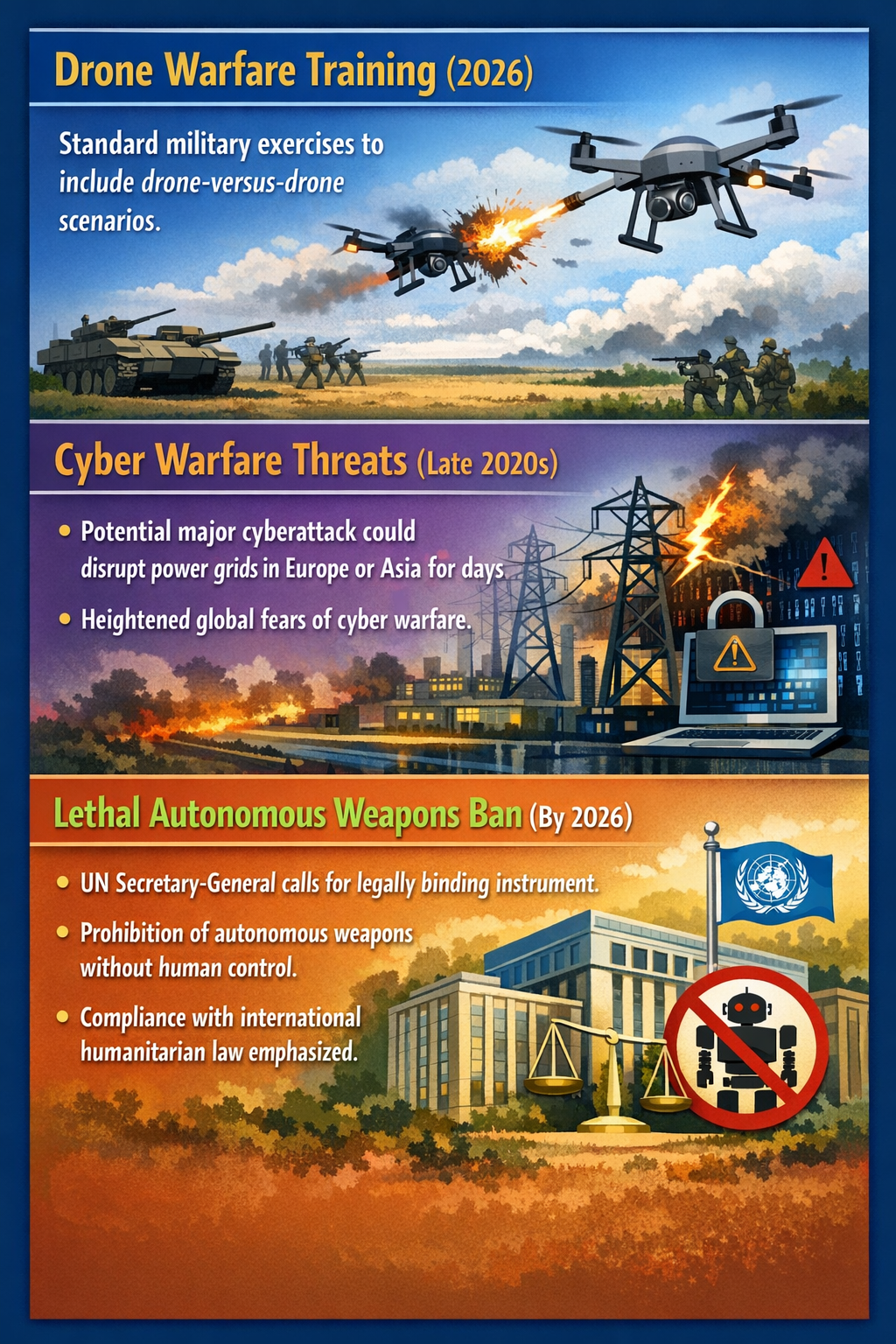
Armed forces are deploying large swarms of inexpensive drones to overwhelm defenses. This approach accepts that many drones will be lost but leverages sheer numbers and low cost to maintain operational advantage. For example, Ukraine’s use of small drones in large quantities illustrates how losses have become an anticipated “routine cost.” This tactical shift is supported by the rapid proliferation of commercial off-the-shelf drone technology, making mass deployment feasible at competitive prices.
Technological advances also reduce individual drone complexity while enhancing swarm coordination through AI and networked communication. These developments enable coordinated attacks, reconnaissance, and area denial operations at scale. The future battlefield may increasingly resemble a dynamic swarm environment in which persistent, inexpensive aerial assets saturate contested zones.
Beyond the battlefield, this concept of disposable, swarm-capable drones may find analogues in other sectors. Logistics companies could deploy low-cost autonomous aerial delivery drones en masse to serve high-frequency, low-value shipment routes. Environmental monitoring agencies might use swarms of disposable sensors for transient data collection over large or inaccessible areas without risking costly retrieval operations.
Why is this Important?
This emerging trend redefines cost-benefit calculations in military procurement and operational planning. Allocations may shift from investing in fewer sophisticated platforms to funding mass-produced, simple drones as expendable assets. This recalibration has the potential to disrupt established defense contractors and supply chains, favoring manufacturers capable of rapid, high-volume production.
Operationally, mass drone swarms could make adversary anti-drone defenses obsolete or prohibitively expensive to maintain, effectively changing the balance of military power. Likewise, drone-enabled denial of airspace may degrade enemy situational awareness and complicate battle management for opposing forces.
Industries beyond defense might follow suit. Embracing disposable drone swarms could lower barriers to autonomous aerial operations, accelerating adoption in civil infrastructure management, agriculture, urban planning, and emergency response. Commercial actors would face new logistical challenges related to airspace regulation, drone waste management, cybersecurity vulnerabilities, and privacy concerns.
Implications
Strategic planners in government and industry must prepare for:
- Defense procurement shifts: Emphasizing volume and rapid manufacturing capability alongside AI-driven swarm control software.
- Regulatory evolution: Policymakers may need to update aviation regulations to integrate large-scale, expendable drone operations while mitigating environmental impact.
- Environmental considerations: Plans for sustainable drone materials and disposal processes will become critical as use scales up.
- Cybersecurity risks: Swarm communications and command-and-control systems could be targeted, requiring robust, adaptive defenses.
- Cross-sector innovation: Insights from military deploy-and-accept-loss tactics might inspire cost-effective drone applications in commercial delivery, data gathering, and disaster relief.
For businesses and governments, this trend suggests a possible acceleration toward operational models that rely on redundancy and disposability rather than durability and repairability, challenging traditional asset management philosophies.
Questions
- How might regulatory frameworks adapt to authorize and manage the risks of mass disposable drone deployments for both military and civilian use?
- What manufacturing and supply chain transformations are needed to support rapid scale-up of inexpensive drone production?
- Which materials and design innovations can mitigate environmental impacts associated with widespread drone disposability?
- How can organizations develop resilient command and control architectures to secure and optimize swarm operations amid adversarial interference?
- In what ways might commercial sectors capitalize on military-derived disposable swarm concepts to create new service models or disrupt existing business practices?
Keywords
disposable drone; drone swarms; drone attrition; military AI; autonomous logistics; airspace regulation; supply chain disruption
Bibliography
- Effective drone warfare requires sending large numbers forward - and accepting many will be lost as a routine cost. Business Insider. https://www.businessinsider.com/ukraine-shows-partners-view-small-drones-disposable-2026-2